
The music of a wooden hull: it’s time for Vele d’Epoca in Imperia
The 12-metre yachts that shaped the epic history of the America’s Cup, the schooner Palinuro and many other floating masterpieces: see you in Porto Maurizio from 2 to 5 September.

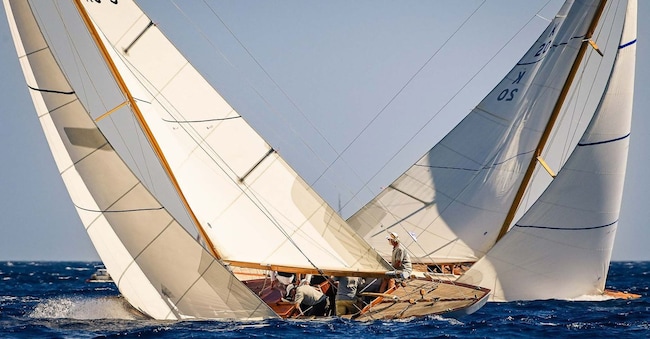
Boats that seek the wind and, at the same time, preserve memories. They carry the scent of freshly oiled teak, the warm sheen of hand-polished mahogany, and immaculate sails that seem to belong to another era and creak softly as they billow. They still sail, and surprisingly well; but above all, they tell a story. It is a story that has been unfolding for forty years in Imperia, where the Vele d’Epoca returns. The 2026 edition is a special one, and HTSI is present in the harbour, on the quayside and aboard the boats. The event celebrates its fortieth anniversary and, to mark the occasion, has doubled the programme with Imperia Sailing Week. First came the World Championship for the 12-Metre International Class – the legendary yachts that starred in the America’s Cup campaigns between 1958 and 1987 (which took place at the end of August) – and, immediately afterwards, from 2 to 5 September, the traditional gathering of historic sailing vessels, which transforms Porto Maurizio into a floating museum open to the public. With one year to go until the America’s Cup in Naples, the regattas evoke the great challenges of Newport and Fremantle and celebrate the twinning between the Museo del Mare in Bagnoli, the Galata in Genoa and the Naval Museum in Imperia. A journey through time, exploring the evolution of sailing: the elegant lines of the 8-Metre International Class sail alongside the historic 12-Metre class yachts that have written some of the most epic chapters in the history of the America’s Cup, whilst authentic floating monuments parade alongside today’s champions. Such as Aria, built in 1935 by the Costaguta shipyard in Voltri, Genoa, and Kookaburra II, the reigning world champion in the 12-Metre class, owned by Patrizio Bertelli, the owner of Prada and Luna Rossa. Also returning is the schooner Palinuro, the Italian Navy’s historic training ship, which was already present at the inaugural edition in 1986 and today upholds a seafaring tradition that continues to train generations of officers and sailors.
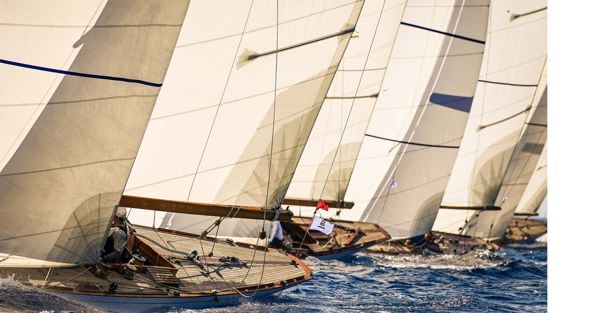
The central figure is Mauro Pelaschier, one of the most iconic names in Italian sailing. A former helmsman on Azzurra during Italy’s first America’s Cup challenge, Pelaschier sees something in vintage sailing that goes far beyond mere nostalgia. ‘I’m delighted to represent all vintage sailing enthusiasts because I come from a family of shipwrights. My grandfather, who was born in Pola, and my uncle built sailing boats to win, back when the technology was all about wood. My father Adelchi and my uncle Annibale inspired me to achieve great things. I grew up amidst shavings of fine timber and in sail-making workshops, where the ‘engines’ of the boats were built. Then life allowed me to experience all the new technologies, from aluminium to Kevlar and on to carbon fibre. But my heart has drawn me back to wood.’ A profound pull, impossible to ignore, which is as much technical as it is cultural and aesthetic: ‘Sailors and boat owners are, first and foremost, people with a passion for beauty. Maintaining and restoring a vessel built a hundred years ago, so that it can race today to the best of its ability, requires care and an understanding of the technology of that era. It means sacrifice and a huge amount of teamwork. Many young people who join the crew are struck by how intensely one can compete with these boats. It goes without saying that a passion for wood – a living, almost eternal material – helps. So does the purity of the lines. For example, those of a wooden hull cutting through the waves, producing not noise but music.’ Perhaps this is precisely the secret of their appeal. In an age when sailing is all about composite materials, navigation software and foils capable of making hulls fly over the water, these boats continue to represent a legacy of expertise, craftsmanship and beauty. ‘If you ask a child to draw a sailing boat, they’ll never sketch a modern one,’ reflects Pelaschier. ‘They’ll draw a tall ship or a classic boat. Try it with your own children. That’s who we are: vintage sailors.” A definition that serves almost as a manifesto: because some boats, rather than ploughing through the sea, seem to travel through time.

