
Musk trial: the balance of the Doge's leadership and next steps
Micheli: 'He is an alien, leave after duties'. Ponzellini: 'I defend Elon, blame bureaucracy'. Massolo: 'Cutting spending requires care'.

3' min read
3' min read
In December 2024, Elon Musk touched unprecedented wealth: $470 billion. In January 2025, he entered the White House as head of the Doge to cut government spending. Five months later, he is exiting that role. With gigantic personal wealth still unmatched, but worth 100 billion less. It is a sign: something has gone wrong. Is cutting public spending more difficult than sending satellites into space? And now, what will he do?
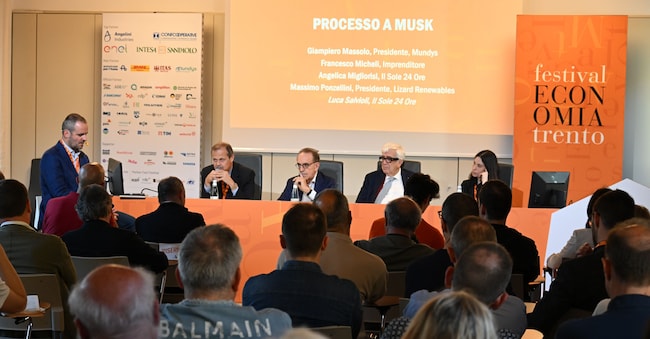
These were the premises of the 'Musk trial' panel held at the Festival of Economics in Trento. "To reform public administration there are processes, it is not like opening a sink at once. There are half measures - says Giampiero Massolo, diplomat and geopolitical analyst, president of Mundys - . Then there is even a tar in the US, and therefore legal procedures for administrative protection. The shock wave was perhaps even healthy. But the cure succeeded and the patient died. But here the patient is in danger of being Musk'.
For Francesco Micheli, entrepreneur and now president of Nextalia, 'Musk is a formidable weasel. I am convinced that he is an alien arrived from who knows what galaxy. His great wealth grew the moment he was co-opted by Trump, then the value dropped, prey to the fluctuations in the stock market value of his companies. He made the decision to step aside when Trump, incompetently and without realising the damage he will pay politically, announced the tariffs. And he is already partly recovering. He remains an incredible character'.
Massimo Ponzellini, now president Lizard Renewables and general manager Kalrock Capital, takes sides: 'In the process I choose to defend Musk. In this political role he presented himself with a baseball bat and I appreciated that. Then, as always happens, he came up against the bureaucracy, which is an impregnable leviathan. He realised that beating around the bush is counterproductive. And in fact where did he succeed? In space, which is no man's land, there are no laws. Between satellites and enabling technologies, he has positioned himself very well for the future. He is going to be extremely rich. Much richer. We are at the aperitif'.
Angelica Migliorisi, author along with the writer of "Elonomics", the book that addresses Musk's thinking, crisis and prospects, takes stock of the Doge's numbers in hand: "Musk had promised a $2 trillion cut in public spending, but the Doge's accounting today stops at $170 billion. There is more: if one looks in detail, only a small part of this figure is well documented, just over 30 billion. From this point of view, the balance of his experience at the helm of the Doge is certainly negative. Governing a country is not like running a business. When you eliminate agencies like Usaid you're not just cutting some costs, you're making sure that in several African countries people no longer get their medicine'.


