Automotive

Musk's party scares Wall Street: Tesla's share price plummets

The birth of the America Party is the tycoon's latest sensational choice. But this time investors do not seem inclined to applaud. The share price sinks (-6.8%) and the board is under pressure. What is Tesla's future?

by Alberto Annicchiarico

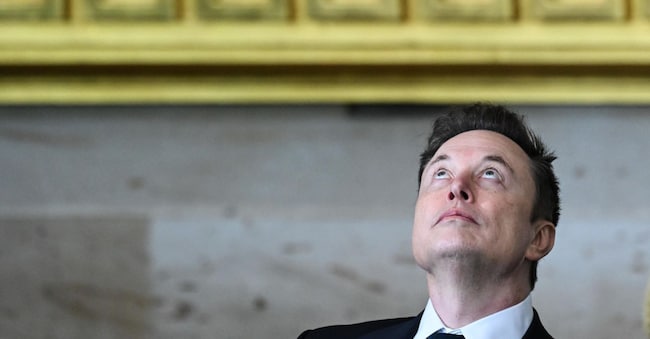
Elon Musk, ceo di Tesla e SpaceX, guarda in alto seduto al suo posto durante la cerimonia di insediamento, prima che Donald Trump presti giuramento come 47° Presidente degli Stati Uniti, 20 gennaio 2025. EPA/SAUL LOEB / POOL

4' min read

4' min read

On Saturday 5 July, Elon Musk announced the birth of the America Party, a new political entity that, in his intentions, should upset the balance between Republicans and Democrats. Yet another out-of-the-blue move, which came in the middle of the long weekend (of Independence Day), and which provoked a predictable reaction: on Monday, 7 July, Tesla's share price dropped 6.8% (to 294 dollars), highlighting investors' concern.

The point is not just the announcement itself, but its significance as it comes. Tesla is going through a delicate phase, with sales declining on an annual basis for the second consecutive quarter, a product offering that is not being renewed and is mainly focused on autonomous driving and robotaxis, and Chinese competition advancing at a faster pace than expected. In this context, Musk's umpteenth return to the political limelight is perceived not as a temporary digression, but as a structural distraction.

Loading...

Politics as interference

The rift between Musk and Donald Trump, which exploded publicly in early June after the signing of the 'One Big, Beautiful Bill', has once again taken on the contours of a personal clash. In blows of X-posts and crossed statements, the Tesla CEO accused the former president of wanting to dismantle subsidies for the electric car (and that's really how it is), while Trump relaunched by evoking cuts in government contracts and federal subsidies received by SpaceX and Tesla.

In between, the creation of a new party, with the aim of influencing some key seats in Congress in the 2026 mid-term elections. For Musk, it is a 'battle of principle'. For many investors, a total gamble, at a time when Tesla needs strategic focus, operational execution and industrial focus.

Usa: Elon Musk lascia il Doge e l'amministrazione Trump

"Investors are tired. They had welcomed the step back from politics after the exit of the Doge (Department of Government Efficiency, created to streamline the federal bureaucracy, modernise government IT systems and above all reduce government spending, ed.) and now they find themselves back in chaos," wrote Dan Ives of Wedbush, historically close to the stock. "Tesla needs its ceo, not a part-time political leader."

Three heart-stopping months

.

In fact, the performance over the past three months represents well the negative reflection of Musk's political exposure and the repercussions of the deteriorating relationship with the president. Between March and April, the climate around the Texan brand had clearly worsened: protests online and in front of dealerships (#TeslaTakedown) and investor concerns about governance. The stock closed down for seven consecutive weeks. On 30 March, after the very negative first quarter accounts (deliveries -13% year-on-year) strong sales and -6%.

At the end of May Musk announces farewell to the Doge. The market reacts with relief, the CEO is about to return to work: +3%. But on 3 June, Musk attacks the 'One Big, Beautiful Bill', Trump's maxi-tax law cancelling subsidies for electric cars: he calls it a 'disgusting abomination'. A new clash with Trump explodes. The president announces reprisals on federal contracts. On 1 July, Tesla loses over 6% after Trump signs the 'Big Beautiful Bill'. The president attacks Musk, accusing him of depending on public funds. The political break appears final, fuelling fears about federal contracts and new retaliation. Investors react with a sell-off, burning some $20 billion in value. Finally, on 5 July Musk launches the America Party. And Wall Street's response is not long in coming at the first opportunity, on Monday 7 July: Tesla falls from over a trillion in capitalisation to 940.

The fall is just under 30% since the beginning of the year. Tesla is now the worst of the 'Magnificent Seven', the leading companies in the technology sector. And, as mentioned, there are growing fears that personal tensions between Musk and the White House could lead to regulatory or contractual reprisals, even in strategic sectors such as space (with Space X) and artificial intelligence (xAI).

The (unplayed) role of the board

The announcement also turned the spotlight back on internal governance. The board of directors, led by Robyn Denholm, is back in the crosshairs. The chairman had denied rumours of a possible change at the top in May, but pressures are mounting. Azoria Partners, for example, has decided to suspend the launch of an ETF on Tesla, and CEO James Fishback has publicly called for a clear stance from the board on Musk's political involvement.

Ann Lipton, a professor of corporate law at the University of Colorado, summed up the problem neatly: 'In another company, the board would have already considered whether the CEO's conduct was consistent with his role. Tesla, on the other hand, has historically adopted a wait-and-see posture, letting Musk freely manage his external initiatives'.

Usa, Musk scende in campo: ecco l'America Party

It is not just a question of symbolic presence. In May, a group of shareholders including New York City pension funds formally demanded that Musk devote at least 40 hours a week to Tesla, signalling fears that the company, while having benefited from its founder's vision, now risks intermittent leadership.

Numbers and Competition

.

The alarm is borne out by the results. In Q2 2025, Tesla delivered 384,122 vehicles, an improvement over the previous quarter (+14.1%) but still down 13.5% year-on-year. The top models (S, X and Cybertruck) are stationary at 10,394 units, down 52%. Model 3 and Model Y continued to drive the result, but the product mix was depleted and margins suffered.

Meanwhile, Chinese competition accelerates. Not only Byd. The Xpeng-Nio-Li Auto-Zeekr patrol overtook Tesla for the first time in the second quarter, with a lead of 33,000 deliveries. Two years ago, the gap was over 300,000 vehicles in favour of Tesla. The lead is no longer a given. And Musk knows it.

Casa Bianca, Trump: "Il partito di Musk? E' ridicolo, serve solo a farlo divertire"

The question that comes back

.

The central question remains the same, and is now being discussed by analysts and investors: is Musk still Tesla's main asset or is he becoming a huge problem? Until now, his ability to drive the electric transition and the future of autonomy has granted him almost absolute freedom. But today, with a product line under pressure, an unfavourable regulatory framework and governance perceived as too weak, tolerance for his political digressions may be at its limits. The risk, for Tesla, is not just of losing focus. It is to lose control.

Copyright reserved ©
Loading...

Brand connect

Loading...

Newsletter

Notizie e approfondimenti sugli avvenimenti politici, economici e finanziari.

Iscriviti