United States

Musk pays the price of politics: Tesla collapses, and doubts grow over Space X

A year ago, Elon first tweeted his support for Trump. Today, a year later, his companies are paying for risky choices

4' min read

4' min read

Looking at the latest quarterly results of Tesla, grappling with a drop in sales never seen in the last ten years, a rather obvious question arises: who knows whether Elon Musk, if he could go back to 13 July 2024 - the day Donald Trump was shot - would make the same choices again. Because since that famous tweet posted immediately after the shooting that miraculously wounded Trump only in one ear ("I fully endorse President Trump and hope for his rapid recovery") the dynamics around the South African-born billionaire have changed radically.

Since that day, Musk has gone from being a more or less anonymous wealthy Republican campaign contributor, to Trump's first and foremost supporter. Over the course of the next few weeks, support quickly turned into physical appearances at rallies, supportive interviews, and even formal institutional roles sanctioned with Trump's return to the White House.

Loading...

Since July of a year ago, in short, the figure of Musk has ceased to be that of a controversial entrepreneur, visionary and little inclined to political correctness. And for months it has become the ultimate expression of Trumpism. Undisputed idol of the Maga movement. In many respects a substitute for Steve Bannon, at least on the surface.

A considerable exposure, with contrasting effects. On the one hand, business seemed to be booming: on 31 July 2024, Tesla was worth around USD 811.5 billion (with shares trading at around USD 232), while on 31 December (with Trump already victorious) the value had skyrocketed to around 1.5 trillion. But there was also enthusiasm around Space X and all the other companies in the Musk macrocosm. The proximity to Trump was seen as an incredible opportunity for Elon's companies. Of course, there was already an air of conflict of interest. For what it's worth, in contemporary political perception.

Musk's friend of The Donald and top Doge, however, soon walked into something of a trap. At least that's what the results say. The ceo's political exposure became so unwieldy that Tesla itself soon ended up as a symbol of Trumpism, with hundreds of cars being targeted around the world, including vandalism and forms of protest. And sales plummeted (but not only) because of this, with thudding all over the place. Even videos of stars who have sold their Teslas in disagreement with Musk's choices have gone viral on social media.
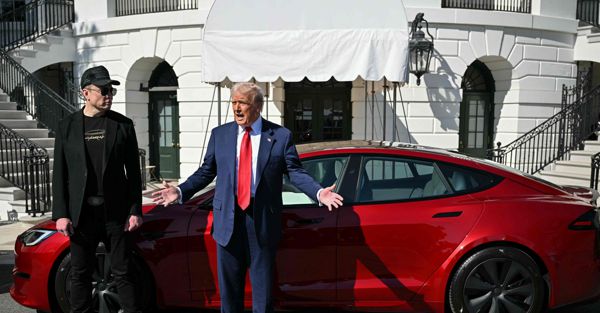
These are the first creaks. In March, Trump himself is called to symbolic action to try to right the company's fortunes: he buys two Teslas, summons journalists and is filmed in front of the White House praising the car (which he cannot even open).

The truth, however, is known: Trump and his voter movement detest electric cars. It is written in the American political history of the last decade. Not even Musk's millions have managed to change his mind.

And if you add to this the amount of enemies Musk has managed to make in just a few months at the Doge, you get what Professor Scott Galloway (lecturer at New York University) has called 'one of the greatest destructions of a brand'.

The squeaking becomes an earthquake at the beginning of June, when the more classic formulation of two roosters in the same henhouse becomes apparent. Neither is willing to crow at dawn any longer.

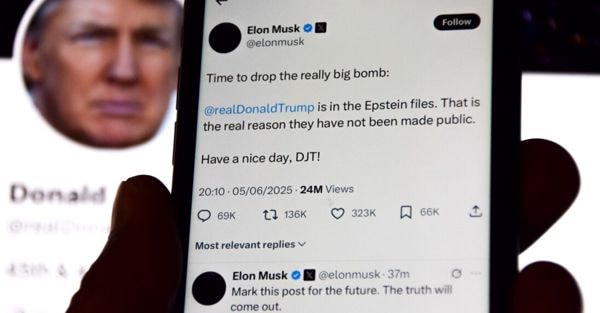
Musk openly criticises Trump's 'One Big Beautiful Bill Act'. The clash that arose on social media was fierce, with accusations and threats. Musk blurts it out in a post on X on 5 June: '@realDonaldTrump is in the Epstein files. That is the real reason they have not been made public' (Trump is in the Epstein case files. And that is the real reason they have not been made public). A very heavy accusation (later deleted and withdrawn), but one that turns the spotlight on a case that seems to be coming to a head these days.

Then he even decided to launch his own political project. A sort of Italian-style third pole (don't blame Musk).

Trump reacts by threatening Musk's companies (although Steve Bannon - yes, him again - recommends deporting the entrepreneur to South Africa). And Tesla (which is also the only public company in Elon's galaxy) suffers. The company is paying for the Ceo's political exposure, and serial sales fall and profits go up in smoke.

But it is also - and perhaps above all Space X - the real unknown. The satellite company, flagship of the US aerospace market, with dozens of billion-dollar contracts with NASA and decidedly prosperous future programmes in hand, has rediscovered itself as fragile.

Trump is looking for alternatives. And that is a fact.

Last May - when hatred had not yet exploded between the two - the White House announced the Golden Dome project, a 175 billion missile defence system. Space X seemed destined to be the centrepiece of this project, but now Trump is looking elsewhere. For example, at Project Kuiper, Amazon's satellite network, Space X's direct competitor, although technologically there seems to be little match between the two companies (in favour of Musk's, clearly).

Elon, meanwhile, has already reacted with a rather explicit post on X: "Federal takeover regulations dictate using the best supplier at the best price. Anything else would be a violation of the law'.

The point is that Musk, today, seems rather lonely. With his political exposure and his job at the Doge, the richest man in the world has made scorched earth in the Democratic electorate. And now, the split with Trump has left him with few friends on the other side as well.

That is why the future of its companies seems less solid. That is why the story of Space X and the Golden Dome seems like a loud wake-up call.

The latest chapter in a still long saga. Still unpredictable.

Copyright reserved ©
Loading...

Brand connect

Loading...

Newsletter

Notizie e approfondimenti sugli avvenimenti politici, economici e finanziari.

Iscriviti