
Musk scales back NASA’s plans for a moon landing
NASA risks being left without the Falcon, whilst the Spaceship is still in its trial phase, as China races ahead

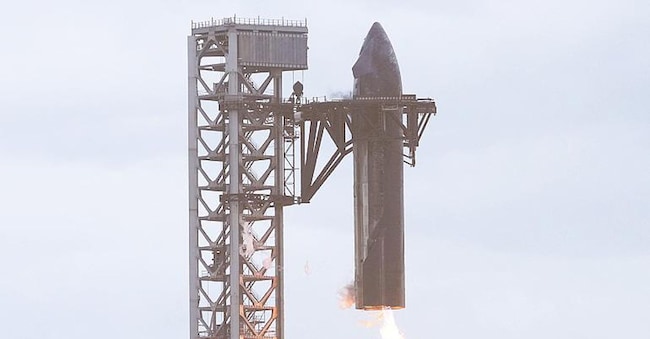
Two very different scenarios for SpaceX in the space of two days. On Friday 13 November 2026, the first stage of Starship, the Super Heavy, attempted to return to the Starbase tower in Texas, but during re-entry its on-board computer detected that something was amiss; it abandoned the planned in-flight docking with the base, veered off towards the Gulf of Mexico and exploded on impact with the water. On Saturday 14th, however, after 22 and a half hours and fourteen orbits around the Earth, the second stage – having deployed 26 next-generation Starlink satellites – returns home and is caught mid-air by the tower’s gigantic mechanical arms, to the delight of the many spectators. This is the first time a vehicle returning from orbit has managed this feat, and this one is large, heavy and very fast.
The success of Starship
Starship Flight 15 is therefore a success: recovering an upper stage intact after it had travelled through the atmosphere at over 27,000 kilometres per hour is a feat that no one had ever achieved before. But SpaceX’s dream of a rocket that is fully reusable, like a commercial aeroplane, is not yet a reality. The first stage, which had already been recovered three times previously, came to a halt too early on this occasion: the engines performed slightly below expectations and there was insufficient propellant, according to Musk himself. Starship is nonetheless an extraordinary step forward, though not yet a perfect system; when it is, the cost of reaching orbit will hit an all-time low and the space industry will be transformed.
SpaceX, however, is confident and is acting as if it were already a reality. In August, Musk wrote that, once Starship is flying reliably several times a week, it will make sense to shift personnel and resources to the new rocket and phase out the Falcon. These words left many observers stunned. The Falcon 9 is the company’s workhorse: 165 launches in 2025 alone, more than half of all orbital flights on the planet, and hundreds of missions over the last three years with first stages landing and relaunching dozens of times. It is the rocket with which it has beaten the competition and turned space into a genuine market. Now SpaceX is no longer selling commercial launches beyond 2028, has stopped producing certain non-reusable parts and has already transferred Starlink launches from Florida to Starship. There are fears of a gap: the alternatives, from the American Vulcan to Blue Origin’s New Glenn, are still a long way from matching that pace.
The military alliance
Then there is another aspect that is rarely discussed, because little is known about it. SpaceX is becoming increasingly closely linked to the US military. Through its Starshield division, it is building classified constellations, based on the same platform as the Starlink satellites but exclusively serving the Pentagon and the intelligence services. In May alone, it secured contracts worth around $6.5 billion linked to the ‘Golden Dome’, the missile defence shield commissioned by Washington: a military communications network and a system for detecting aircraft, drones and missiles from orbit. In the first half of November, Falcon 9 rockets launched two secret payloads into orbit for the Space Force, and further launches are scheduled, alongside new spy satellites for reconnaissance. Orbits, the number of satellites and their missions remain secret. It is an increasingly close partnership, making the private company a pillar of US defence.
The most sensitive issue at present concerns NASA. The space agency has built its most important programmes around SpaceX: the Dragon capsule is currently the only reliable American means of transporting astronauts to the International Space Station, and a version of Starship is expected to be the vehicle that will return humans – and materials – to the Moon. However, SpaceX has announced that it will cease flying the Dragon by 2030, has pulled out of launching the small lunar landers for NASA’s commercial programme and, according to the American press, has placed the Moon behind other priorities, ranging from data centres for artificial intelligence to Starship itself.


