
“My name is Orson Welles”: an exhibition in Turin celebrating the genius of cinema
At the National Cinema Museum in Turin, a journey through illusion and reality dedicated to the great director and actor

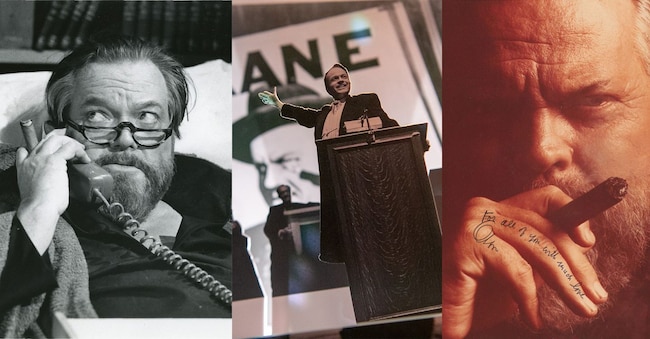
It is a face that becomes many others, in a process of transformation that is the very embodiment of the essence of his cinema: illusion as a means of reaching the truth. The face of Orson Welles that punctuates every stage of his career; the director’s ever-changing faces that observe the viewer and, at the same time, captivate their attention, just like his films. These many faces form the backbone of the exhibition “My name is Orson Welles”, conceived by the Cinémathèque française and curated by its director Frédéric Bonnaud, hosted until 5 October 2026 by the National Cinema Museum in Turin.
The Illusion
“Whilst cinema throughout the 20th century moved towards imitating reality, Welles took the opposite path – that of illusion, trickery and fiction, which reaches another level of truth”: this is how the Museum’s director, Carlo Chatrian, describes the style of a true legend and a brilliant filmmaker. The exhibition is based on this vision and unfolds along the spiral ramp of the Aula del Tempio in the Mole Antonelliana: transformism serves as the common thread of an exhibition featuring over 400 items – some of which have never been seen before – drawn from various public and private collections and from the Orson Welles Collection at the National Cinema Museum. In every panel or section, it is precisely Welles’s face that takes centre stage, introducing an in-depth exploration that winds its way through writings, posters, playbills, videos and drawings, which reveal the director’s immense creativity and visionary spirit: indeed, the exhibition design itself, by juxtaposing the various materials, offers visitors a journey – a visual one as well – into this hyper-creative world, which seems to come to life right before the observer’s eyes.
The trials
His experiments – including technical ones – with a look at some of the cameras he used, his passion for illusionism, and his use of scenic tricks (with a reference to the famous mirrors in *The Lady from Shanghai*): these are all elements that combine to evoke the atmosphere of Welles’s works. And not just his cinematic works: among his radio productions, his famous adaptation of *The War of the Worlds* – broadcast from the RKO studio and ‘recreated’ in the dedicated chapel at the Caffè Torino – remains unforgettable.
“Citizen Kane”
The focus then shifts to his life, to his childhood – when his genius was already evident – and to his discovery of and love for Shakespeare. Next, what is regarded as one of the greatest – if not the greatest – films of all time, *Citizen Kane*: the immersive installation dedicated to Rosebud, featuring the iconic snow globe, as well as the sledge and the perspective effect in the shot of Kane during the rally. The creation of this imaginative and innovative film is thus reflected in the objects and memorabilia on display.
“F For Fake”
And furthermore, the journey through his productions, other memorable films, his adaptations of the Bard’s works (from *Othello* to *Falstaff*), his arrival in Europe, his acting engagements to fund his projects, his unfinished works, and his final ‘essay films’. The milestones of an intense career brought to life by the many pieces featured in ‘My Name Is Orson Welles’: among other things, the drawings stand out, and, in particular, the editing room lined with stills from ‘F For Fake’, one of the films that best exemplifies the use of this medium as a language. In addition to the material from the Paris exhibition, the Welles Collection from the National Cinema Museum is also on display, as mentioned, comprising – amongst other items – his birth certificate, pages of screenplays with notes, story outlines, photographs and posters. Also on display for the first time are Guido Crepax’s illustrations for *The Immortal Story*, stories by Karen Blixen adapted for the screen by Welles.

