Interview with Gabriele Muccino

My selfish fifties and the things that success cannot say

The Roman director reflects on his artistic journey and the dynamics of his films, including his latest, 'Le cose non dette'

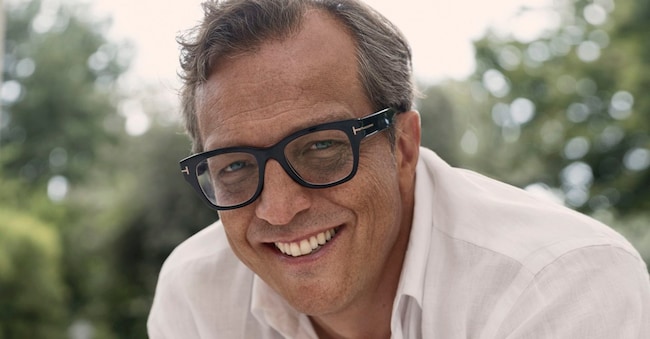
by Cristina Battocletti

Regista e sceneggiatore. Gabriele Muccino

6' min read

Translated by AI
Versione italiana

6' min read

Translated by AI
Versione italiana

You can make a film like The Last Kiss that changed the course of Italia cinema with a 13 million box-office at a time when (2001) the only successful films were comedy films. You can be dragged on stage at Sundance for the audience award, while you are getting on the plane to go home because you just didn't expect it, and then be called to Hollywood to shoot The Pursuit of Happyness (2006), with which Will Smith by a whisker does not win the Oscar. You can direct stars like Catherine Zeta-Jones, Uma Thurman and Russell Crowe. You can stay at the top of the box office - Remember Me (10 million, 2003), Bake Me Again (9 million in 2010) - and dread the theatrical release of your new film. It happens to many artists and also to Gabriele Muccino, whom the "Sole 24 Ore" met in a Milanese hotel, during one of the stops on the presentation tour of Le cose non dette, which a month after its release has made more than 6.5 million at the box office and remains fourth in the Italia box office below Wuthering Heights, the Disney film Rental family and Hamnet, in Oscar odour.

The fear of etiquette

"It is always a time to be tested. I am not afraid of criticism, sometimes I find it specious, I always get blamed for the same things. Success changes other people's gaze on you and judgements become stronger or more extreme, often superficial. They stick a label or an adjective on you that represents you and in which you do not fit. You are taken away from the possibility of stumbling, of making a wrong picture. And then we are biologically unprepared for the planetary exposure of social: it has never happened in human history. When Remember Me surpassed The Last Kiss I learned to handle success with a little more disenchantment, telling myself that it too would pass. I try to repair myself, but never enough because I am the son of an analogue generation, where the body is your true and only vehicle'.

Loading...

Between Tangier and Rome

Le cose non dette (The Unspoken Things), starring two pairs of middle-aged friends, Carlo (Stefano Accorsi), Elisa (Miriam Leone), Paolo (Claudio Santamaria) and Anna (Carolina Crescentini), who live in Rome and take a holiday in Morocco, is also very much about the body. While Rome hides, Tangier reveals: 'It is a bubble away from home where masks can fall. Tangier is a magnetic place, a gateway to Africa with Anglo-Saxon and French influences, a destination for writers, smugglers and even Garibaldi. Here my protagonists have the illusion that they can shift their gaze and create change within their stalled lives. They are looking for some serenity and, instead, the skeletons hidden in the cupboards of the unspoken will come out and blow the table".

Inspired by the American novel 'Syracuse'

Hence the title, Le cose non dette, which is loosely based on the novel Siracusa by Delia Ephron (Fazi, 2018), author of the screenplay together with Muccino himself. In the book, however, there are four Americans on holiday in the Sicilian city. "I changed destination because, first of all, we are a people with a much warmer temperament. This is a film about implosion, caused by not knowing ourselves, not asking who we are, not being able to tell the truth because it is uncomfortable, because it hurts, because it is judged, because it is blamed. Americans experience different implosions from ours: they argue much less, they verbalise little and compensate with alcohol and much more.

The protagonists in their fifties

The result, however, does not change, you break out even if in different ways that make a difference'.The characters in Muccino's films grow with the director's age. In The Last Kiss they were thirty years old, today they are fifty. And, in part, Accorsi and Santamaria, the protagonists of the two films, share the same names, Carlo and Paolo. "With these actors I have shared important paths, films that define you and with which I have known success. With Santamaria I also made my debut in Ecco fatto in 1998. For me they are a strong point".

The sentimental diseducation of young people

What is really surprising is the point of view of the teenagers, in this case Vittoria (Margherita Pantaleo), Anna and Paolo's daughter. "Teaching acting in my spare time I have to deal with young people ranging from 15 to 25 years old, so I know perfectly well who Vittoria is and who Blu is - Beatrice Savignani, a philosophy student in the film ed. Young people do not have the filters of disenchantment that, on the other hand, adults add with experience, disappointed by things that did not go as they wanted. Young people are hopefully not yet wounded, they have the truths in their pockets and the naivety to think that if you love, you do it absolutely and forever. This makes them strong, powerful, impetuous and deflagrating. But in Vittoria's character there is a sentimental diseducation, because the parents are selfish, turned towards their own narcissisms, their own fear of growing old, rather than embracing ageing and maintaining the role of parents. Thus, children in an age where you no longer verbalise with your voice, with your body, but with a mobile phone, are unprepared for the formative disappointments of growing up, which build character and make you accept abandonment. What the very young really lack is being together in an analogical way, because that is where our collectivity is formed, the knowledge of the body and how to relate it to that of others'.

The Cinema Box

In this the cinema and the auditorium can help. "The cinema is a wonderful optical box in which we all get together and share emotions. This film also has a lot of them and is full of impulses. I can tell by the reactions of the audience, which is very attentive. Sometimes it bursts into cathartic laughter, because there are tragicomic or even simply comic moments. The audience's response is much greater than I expected. I was afraid they would get confused in this labyrinth of characters that, instead, they decode very well. I start from my point of observation, which has always been that of someone outside the arena. I have had a ten-year apprenticeship, so when I made my debut I was ready to tell my view of the world knowing what language of cinema I wanted to use, learning more and more how to direct actors and bring them up to that temperature that many directors consider exhausting. For me, it is a mode of exasperation that lies within my characters, who arrive at a crossroads, dragging a different crisis from the one that intellectuals make explicit by reading and feeding on silences.

The change of course

My protagonists are like many of us, sometimes exhausted and on the brink, wanting to drastically change their lives. It is a leitmotif that recurs in all my films, even the American ones, such as The Pursuit of Happiness, Seven Souls, Fathers and Daughters. My heroes try to change the course of their lives and that is why I decided to be a director'. There will also be a more cinematic reason.... "Bicycle Thieves and Vittorio De Sica's Umberto D. Especially the latter, which in his simple, ordinary life tells a macroscopic and universal story. And in some ways that is what I also try to do: observe people and their intimate relationships. Individuals who are, all in all, simple, but very articulate, because we are, in any case, very complicated'.

Slow motion

In The Unspoken Things the camera is very mobile, with a marked use of slow motion. "Slow motion is the fragmentation of what the eye fails to capture. For example, the micro expressions we make at important moments, which are often unreadable because they are too fast. Slow motion makes the moment rarefied and explores it cinematically to present it to the viewer. Emotionally it has an important impact, a kind of boldness underneath the words'.

Actor's Life

In 2023 and 2024, the Roman director happened to be in front of the camera playing himself in Vita da Carlo 2 and Call my agent-Italia. "In truth, when I was 21 I acted for nine months in a sitcom produced by Pupi Avati, but I already wanted to be a director. I suffered a lot because I was totally uncomfortable, but it helped me to understand the torments of actors more deeply. In Call my agent-Italy I parodied myself, having fun being ironic about all my neuroses'. Since he appeared with a giant horn around his neck, perhaps superstition was among them... 'No, it was a necklace I found in my hands. I don't have any form of superstition, on the contrary, I go towards him. If there's a ladder I go under it, if a black cat crosses I jump right behind it. In my second film, Come te nessuno mai, the main character was dressed all in purple'.

Repeat "Remember me"

Would you remake one of his films? "I would love to remake Remember Me, because it is so visionary that it could be a nice experiment. Hitchcock did it with The Man Who Knew Too Much 20 years later, and it also won an Oscar (for best song, Que sera sera, sung by Doris Day, ed.). It would be an interesting challenge, although it never does me any good to look at my films again, because if they are good, I am afraid that I am no longer up to making an equally good one. If they are mediocre, I am ashamed.

© REPRODUCTION RESERVED

Copyright reserved ©
Loading...

Brand connect

Loading...

Newsletter

Notizie e approfondimenti sugli avvenimenti politici, economici e finanziari.

Iscriviti