
Hvaldimir, the beluga whale alleged to be a Russian spy, found dead in Norway
The lifeless body of Hvaldimir, the beluga whale suspected of being a Russian spy, has been found in Norway, reigniting speculation about the training of marine mammals
2' min read
Key points
2' min read
Over the weekend, the waters of south-western Norway returned the lifeless body of Hvaldimir, a beluga whale that had attracted worldwide attention in recent years for its suspected link to the Russian army. The animal's body was found adrift off the coast of the town of Risavika and subsequently transported to the nearest port for a post-mortem examination. The whole affair has reignited speculation about Russia's alleged espionage activities through the training of marine mammals.
The meeting with Hvaldimir and the first speculations
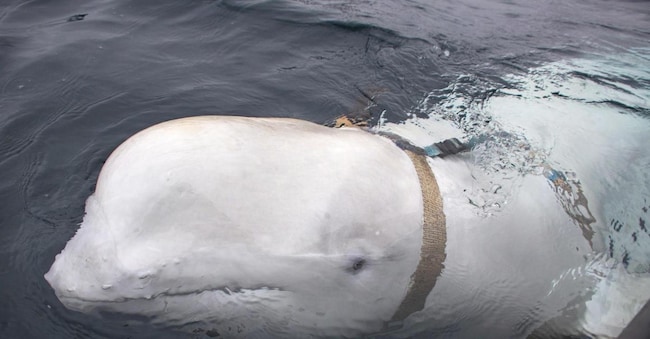
.Hvaldimir had become notorious in 2019, when it was first spotted near the island of Ingoya, some 415 km from the Russian city of Murmansk, home of the Russian Northern Fleet. What made the encounter particularly intriguing was the fact that the beluga was wearing a harness to which a GoPro camera was attached, marked 'Equipment of St Petersburg'. A detail that immediately sparked rumours and theories about the whale's possible training for espionage purposes by the Russian armed forces, a hypothesis never officially confirmed by Moscow.
Loading...
The Norwegian authorities launched an investigation through their domestic intelligence agency and came to the conclusion that the whale may indeed have been trained by the Russian army, as it seemed accustomed to human presence and particularly docile. Hvaldimir, a name that was a play on words between 'hval', meaning 'whale' in Norwegian, and 'Vladimir', in reference to the Russian president Vladimir Putin, quickly became a local and international celebrity.
The discovery of the death and the ongoing investigation
.Hvaldimir's body was recovered by the Marine Mind organisation, which had been tracking his movements for years. The organisation's founder, Seb>Sebastian Strand, told AFP news agency that although the cause of death is still unknown, no obvious injuries were found on the whale's body. "We were able to recover its remains and place it in a refrigerated area in preparation for the autopsy by the veterinary institute," Strand said. With an estimated age of about 15 years, Hvaldimir was still young for a beluga whale, a species that can live up to 60 years, making his death all the more mysterious.
Hvaldimir's legacy and the unanswered questions
.The story of Hvaldimir not only raised questions about Russian military activities, but also brought to light the complex relationships between humans and marine mammals. Russia has a long tradition of training animals such as dolphins and whales for military purposes, a practice that dates back to Soviet times. Recent satellite imagery and field investigations have revealed the presence of whale cages near Russian naval bases in north-west Murmansk, fuelling further suspicions about Moscow's intentions.Despite much speculation, the Russian government has never openly addressed allegations concerning Hvaldimir's training or the existence of programmes to turn marine mammals into spies. The death of this symbolic whale leaves many questions unanswered, and as experts prepare to perform an autopsy, the world remains waiting to discover the truth behind the mystery of Hvaldimir.
Copyright reserved ©


Brand connect
Loading...
