Digital Economy

Pellegrini (Namirial): '15% of world trade will be agent-to-agent'

The company announced the launch of an onboarding platform designed to simplify customer acquisition and secure digital interactions
by Luca Tremolada

3' min read

Translated by AI
Versione italiana

3' min read

Translated by AI
Versione italiana

There is a piece of technology that doesn't usually make the cover. It doesn't make the scene like chatbots. It doesn't promise magic. But it is what decides whether a customer enters, signs in, identifies himself and stays within the perimeter of the rules. It is called onboarding. And Namirial has decided to turn it into a unique platform, tailored for a market where artificial intelligence will not just be an assistant, but a counterpart.

Namirial does a less visible but decisive job. It builds the tools that make digital transactions valid, secure and traceable. In practice: it identifies people online, allows documents with legal value to be signed, and stores those documents according to the rules. It is the least spectacular part of the digital transformation. But it is the one without which banks, insurance companies, public administrations and platforms cannot get customers and users on board.

Loading...

The company announced the launch of a new onboarding platform designed to simplify customer acquisition and secure digital interactions. The package brings together three building blocks that usually live separately: identity verification, e-signature and compliant digital storage. All within a single solution, delivered by a Qualified Trust Service Provider, thus within the regulatory enclosure of eIDAS. In other words: less friction, fewer steps, more legal certainty.

This is not a technical detail. It is a change of scenery. Because onboarding is the tollgate of the digital economy: there the queue is formed, there time is wasted, there trust is measured. And in regulated markets - banking, insurance, public administration, marketplaces - trust is not an abstract value. It is a procedure. Better still: it is an infrastructure.

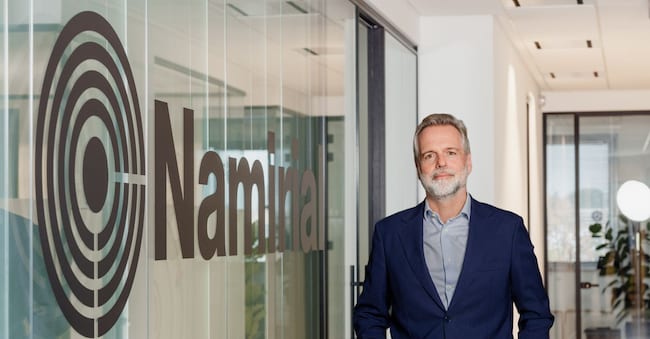
Max Pellegrini, managing director of Namirial, sees it this way. On his horizon there are not just customers talking to companies, but software agents talking to each other. "In our future I see a great deal of interaction between the whole agent world," he explains. And he adds a prediction that sounds like a pebble in the pond: "By 2030, 15 per cent of world trade will be agent-to-agent. If this really happens, it means one very concrete thing: an increasing share of transactions will no longer be through human clicks, but through automated systems capable of deciding, negotiating, buying.

Here comes the point. If two agents are transacting, who guarantees who they are, under what mandate do they operate, what responsibility do they carry? Pellegrini uses a digital veteran's metaphor. He speaks of a new 'HTTP moment'. Like when, in the mid-1990s, the web stopped being a protocol for initiates and became the Internet's high street. "This channeling is very clear to me," he says. "It is the same feeling I had in 1995 when I discovered the Internet". Translated: today we are looking at a phase transition. Not a product upgrade, but a change in the grammar of transactions.

This is why Namirial is trying to position itself not as a simple signature or identification provider, but as a trust hub. "A huge opportunity opens up because you need a fiduciary infrastructure to certify these transactions," Pellegrini observes. It is a phrase that weighs especially heavily in areas where error is not allowed or is costly: credit, policies, administrative paperwork, digital contracts. If AI becomes the engine, someone has to build the guardrails.

But in Pellegrini's analysis there is also a message for the technology industry. The next battle, he says, will be played out on 'agent-ready' products. Not software waiting for instructions, but tools capable of acting autonomously within verifiable boundaries. It is an important shift: from tool to actor. From button to delegate. And when software becomes delegated, trust ceases to be a side function. It becomes the product.

The yardstick by which companies' success will be measured will also change, according to Namirial's CEO. "Success in the future will be based on the revenue you make, not how much you have reduced productivity," he says. It's an interesting, almost counter-intuitive jab at a season when AI is mostly told as a cost scissor. For Pellegrini, the point is not to cut. It is to do more. Much more.

The litmus test will be internal. "I expect to double the business without increasing the number of people so much," he explains, pointing out that the expectation is to be able to increase productivity "with the same number of people". It is not automation replacing work. It is something more subtle and, in some ways, more realistic: the same team being able to push a higher volume of activity because the software takes the repetitive load and leaves the exceptions, the design, the final responsibility to the humans.

Copyright reserved ©
  • Luca Tremolada

    Luca TremoladaGiornalista

    Luogo: Milano via Monte Rosa 91

    Lingue parlate: Inglese, Francese

    Argomenti: Tecnologia, scienza, finanza, startup, dati

    Premi: Premio Gabriele Lanfredini sull’informazione; Premio giornalistico State Street, categoria "Innovation"; DStars 2019, categoria journalism

Loading...

Brand connect

Loading...

Newsletter

Notizie e approfondimenti sugli avvenimenti politici, economici e finanziari.

Iscriviti