
Nan Goldin. When the photographs start to flow
From Milan to Paris (Grand Palais) the great European retrospective of the slideshows that transformed photography into autobiographical cinema

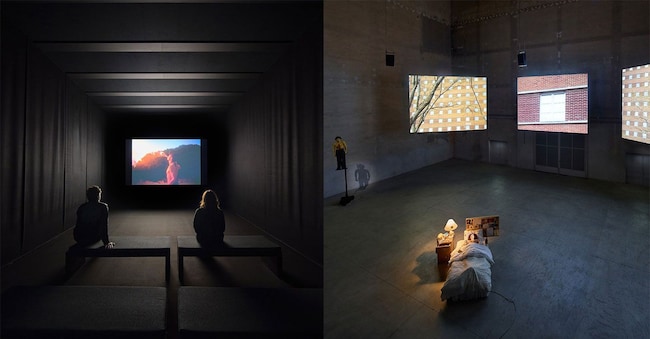
Nan Goldin has been photographing the same subject for forty years: friends, lovers, wounds. Then she edits everything like a film. Not photographs hanging on the walls but sequences of still images, diaporamas and videos that the Grand Palais presents as the first French survey of her work as a filmmaker. One of the most erotic and intense voices in contemporary art and photography, Goldin takes nights, flats, drugs, fights, kisses and assembles them. Photography becomes montage and therefore narrative. Hence his radical strength as an activist of intimacy, far from the mainstream and the usual pandering of 'artivist' art. It is from this short-circuit that This Will Not End Well, opened in Paris until 21 June 2026: an exhibition that works like a cinema without a camera.
Passaggio a Nord-Ovest: the Milanese antecedent
Before arriving in Paris, the exhibition travelled to Stockholm, Amsterdam, Berlin and Milan. And it was precisely at the HangarBicocca that Goldin's works almost found their natural habitat: an underground club night cinema, closer to 1970s New York than to museum photography. Hala Wardé's set design transformed the exhibition into a village of dark pavilions. It is not an exhibition to be walked through, but a sequence of narrative rooms. In this context, the immersive dimension works perfectly.
Goldin's slideshows work like this: images born in everyday life that, once mounted, continue to generate time, narrative and community. At the Grand Palais, this device is extended to the Chapelle Saint-Louis de la Salpêtrière, where Sisters, Saints, Sibyls returns. In Paris, the retrospective thus becomes an itinerary in two acts, almost an urban montage.
A collective novel written with light
The heart of the retrospective remains The Ballad of Sexual Dependency, an open diary begun in 1981 and continually reassembled. An expanded autobiography fuelled by drag queens, broken couples, desire, addiction. In these images, there is above all a radical, almost political sensuality: the bodies are close, vulnerable, often wounded, crossed by an erotic and nocturnal tension that, at times, recalls the restless dimension of David Lynch's cinema. Alongside Ballad are The Other Side, Sisters, Saints, Sibyls, Memory Lost, Sirens and Stendhal Syndrome, where Goldin again broadens the language by integrating movement, voices and archives. In this sense, his work is perhaps closer to autobiographical literature - from Hervé Guibert to Annie Ernaux - than to traditional photography: each image is a page, each slideshow a syntax of experience. Hans Ulrich Obrist has repeatedly observed that contemporary art becomes interesting when languages stop defending their boundaries. Goldin's slideshows work exactly like this: photography that becomes cinema, diary that becomes collective narrative.
Time within images

