Mind the Economy/ Justice 126

Nancy Fraser and the four wounds of 'cannibal capitalism'

Fraser identifies three wounds: care, nature and democracy, all reflecting the predatory order of capitalism

by Vittorio Pelligra *

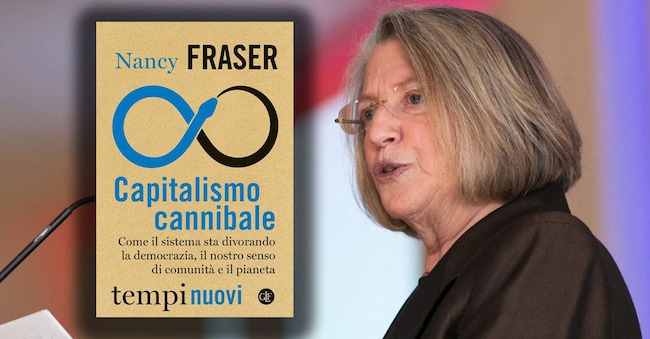
La filosofa Nancy Fraser (Afp)

8' min read

Translated by AI
Versione italiana

8' min read

Translated by AI
Versione italiana

There is a sentence in the opening pages of Cannibal Capitalism, the latest book by philosopher Nancy Fraser, that has the force of a sentence: capitalism is like an ouroboros, the mythological serpent that devours its own tail. It is 'a system,' writes Fraser, 'programmed to devour the social, political and natural bases of its own existence - and consequently of ours' (2023, p. 13). It is not just an image of impact, this, nor yet another metaphor destined to circulate for a few seasons in the public debate. It is the starting point of a diagnosis that Nancy Fraser elaborates with theoretical rigour and militant passion: capitalism, in order to function, must incessantly consume what is not market; but in doing so it erodes those very conditions that allow it to function. It is a machine that feeds itself by destroying its own foundations. Fraser's analysis does not limit itself to pointing out side effects or reformable distortions, but works by shifting its gaze to the system's premises, to the extra-economic assumptions that the capitalist economy needs and erodes at the same time. This is where the novelty of his approach lies: capitalism is neither a production apparatus nor a market regime, but 'a social order that allows a profit-oriented economy to plunder the extra-economic supports it needs to function' (pp. 14-15). Those 'extra-economic supports' constitute the places where cannibalism manifests itself. They are not autonomous spheres, but parts of the same social architecture: the reproduction of everyday life, nature, the capacity for collective action, populations made vulnerable by centuries of dispossession. The crisis we are going through today is not the sum of their fractures, but the result of a single predatory logic.

When the cure breaks

The first 'bite' the uroboros takes is in the world of care. Since time immemorial, capitalism has entrusted the task of sustaining human existence - generating new lives, caring for offspring, repairing bodies and relationships - to subjects marginalised by their gender, class, race. It is an indispensable job to care, and yet, paradoxically, it is relegated outside of economic accounting, as if capital could flourish without the patient maintenance of life. The result is a structural paradox: when caring thins out, the entire social edifice begins to shake. Family ties are frayed, the labour force is depleted, collective psychic health cracks. Capitalism needs all these care activities "to which it attributes no monetary value and which, we might say, it uses as free riders". The system takes energy from social reproduction without ever replenishing it. There is no accumulation process that does not depend on this underground fabric of unpaid, invisible and yet decisive activities. It is an opportunist logic, the 'free riding of the life world'

Loading...

Nature exploited

The second wound opens in the relationship between capitalism and nature. On the surface, the modern economic system presents itself as a self-sufficient construction, a rational mechanism that transforms material inputs into monetised outputs. But, observes Fraser, this narrative only looks at the surface. Beneath the visible skin of profits and balance sheets, the metabolism of the economic machine relentlessly degrades energy, materials, biodiversity, without recognising their origins or limits. Nature is treated as a passive, silent, ever-available fund: a mine from which to extract and a dump in which to disperse. But it is precisely this invisibility that has built the current impasse. When Fraser speaks of an 'ecological contradiction', he is not referring to a tension between two values - growth and environment - but to a structure that leads the system to continually overstep the boundaries that sustain it. Capital needs a natural world that provides it with cheap resources and that can absorb the residues of production; but the more this process accelerates, the more the natural world is compromised, rendered incapable of regenerating what has been taken from it. It is a device that consumes the environment as if it were a reproducible commodity at the same rate as financial capital.

Fraser shows how each historical regime of accumulation has its own built-in ecology. The coal of nineteenth-century England, twentieth-century oil, intensive agriculture and mining on a planetary scale, up to the material needs of the digital economy - from rare earths to the energy required for artificial intelligence server-farms and the energy needed to mine cryptocurrencies - repropose, with technical variations, the same predatory logic. It is the tools that change, not the mechanism. Each phase of economic modernity presents its own list of devastated territories, destroyed communities, ecosystems turned into sacrifice zones. Ecological cannibalism is not an accident, it is the internal grammar of the system.

What Fraser emphasises, with particular force, is that this form of cannibalism affects not only ecology, but the very temporality of the system. Capitalism consumes nature as if the future had no value. It devours resources accumulated over thousands of years - geological sedimentations, extremely long biological cycles, fragile climatic balances - at a pace that belongs to the scale of stock market quarterlies. When we speak of global warming, droughts, desertification or extreme weather events, we are only observing the visible manifestations of a deeper process: the compression of nature's time into the time of accumulation. It is a temporal short-circuit that cannot last much longer.

Democracy emptied

The third wound concerns democracy. If care reproduces life and nature ensures its support, democracy provides the instruments of public participation that allow deliberation and the maintenance of social order. But even in this case, the action of financial capitalism produces deleterious effects. The main one - argues Fraser - is to empty these institutions, reducing their capacity to act, and turning them into organs that ratify decisions taken elsewhere. Public authorities and parliaments are increasingly exposed to blackmail by global markets. As in the metaphor of the snake devouring its own tail, the system consumes the regulatory capacity that keeps it stable. This theme, that of the relationship between capitalism and representation, is explored in Scales of Justice in 2008, in which the philosopher shows how without adequate forms of political participation, without the possibility of including in deliberative processes the subjects who suffer the effects of economic decisions, democracy shrinks to the point of becoming an empty shell. It is not enough to redistribute resources or recognise differences; it is necessary to question who defines the political 'we' and who is excluded from it.

Expropriation and resistance

The last 'bite' the uroboros takes is in the regions of dispossession. Fraser insists that capitalism not only rests on the exploitation of those who work, but also on the appropriation of value produced elsewhere, often by disenfranchised populations. And this 'racialised' dimension of accumulation is certainly not a historical accident, but a constitutive condition of this capitalism. The cannibalism of dispossession appears perhaps most sharply in territories where entire populations are regarded as expendable resources. From the enclosures in 18th century England to contemporary land appropriations in Africa and Latin America, the logic is unchanged: to take away livelihoods in order to convert autonomous communities into reserves of disciplined labour. The same happens in global chains of care, where an essential part of Western social reproduction relies on the labour of migrant women, whose economic and legal vulnerability is the very condition of their employability. Or again in extractive areas - from Congo's cobalt to South American lithium - where land becomes a depository of raw materials and the lives of local populations are treated as an external cost. It is here that the image of cannibalism is radicalised: the system not only exploits, but swallows up entire social worlds, rendering invisible the histories, the relationships, the ecosystems it consumes. Slavery, colonialism, land enclosures, borders regulating movements and vulnerability: all this continues to provide capital with cheap resources. The system needs expropriatable groups, expendable bodies, populations whose lives can be disrupted, devalued, exchanged.

The "triple movement"

The 'bites' of the uroboros do not represent parallel crises, but the manifestation of a single syndrome. Fraser makes it clear: 'this is not merely a crisis characterised by rampant inequalities [...] nor merely a crisis of care [...]; it is a general crisis of the entire social order, in which all the calamities converge and exacerbate each other, threatening to devour us' (pp. 18-19). The strength of this formulation lies in its analytical rigour: what appears to be a plurality of problems - migration, climate, weakened democracy, precarity - is actually the result of a single structural principle, the tendency of capital to consume what makes its accumulation possible.

Fraser's is not a moral critique. It is an economic critique in the deepest sense: an order that destroys nature narrows its productive horizon; an order that exhausts care undermines the reproduction of labour power; an order that empties democracy erodes the social legitimacy that sustains it. Cannibal capitalism devours its own future and drags ours down with it.

"Can we find a way to dismantle the social system that is leading us to annihilation?" -the philosopher asks and asks us with the urgency of a political and historical necessity. The way out consists neither in a return to the overwhelming power of a new Leviathan nor in the hope of a capitalism that finds within itself the necessary resources to become responsible. Rather, what is needed is a new imaginary capable of holding together the struggles that are advancing today in a fragmented manner: the feminist struggle, the ecological struggle, the struggle for the dignity of labour and the anti-racist battles. All these claims denounce the same extractive dynamic; all recognise that the problem is not a single dimension of exploitation, but the overall logic of accumulation. Only a movement capable of connecting these fractures - what it calls elsewhere the 'triple movement' - can halt the system's self-cannibalism and imagine different institutions capable of protecting life without consuming it. On this point, Fraser's thought takes up and radicalises the famous Polanyian notion of the 'double movement'. For Karl Polanyi, the history of modern capitalism is the story of a recurring conflict between two forces: on the one hand the drive towards unlimited marketisation, and on the other the social countermeasures that attempt to protect society from the corrosive effects of the market. But in the contemporary world, Fraser argues, this pair is no longer enough. To the tension between market and protection must be added a third, equally decisive one: the drive for emancipation, which in recent decades has expressed feminist, anti-racist, ecologist, and democratic claims. The triple movement is thus the intertwining of marketisation, social protection and emancipation. Each of these forces can become regressive when separated from the others: social protection can degenerate into identity closure or paternalism; emancipation, if captured by neo-liberalism, can turn into competitive individualism; and marketisation, left to its own devices, produces the crises that overwhelm us today. The political challenge before us is to recompose these three drives into a common and convergent path. This means imagining a post-capitalist project that sacrifices neither material security nor individual freedom, while at the same time placing democratic limits on marketisation. The triple movement thus becomes the framework for a policy capable of integrating social justice, justice in recognition and environmental justice, without subordinating one to the others. This must be done before the snake's tail runs out and its jaws reach its head.

* Vittorio Pelligra, Professor of Economics (13/A2), Department of Economics and Business - University of Cagliari

Copyright reserved ©
Loading...

Brand connect

Loading...

Newsletter

Notizie e approfondimenti sugli avvenimenti politici, economici e finanziari.

Iscriviti