
Naples, how Maradona's mural revives the Quartieri Spagnoli
Around the street art work, many new businesses open (+6.5%) and many tourists arrive

5' min read
5' min read
For director Paolo Sorrentino, a Neapolitan from Vomero, it was the hand of God. As he himself mentioned in the title of his penultimate (and largely autobiographical) film work. For many of his fellow citizens of the Quartieri Spagnoli, Diego Armando Maradona's passage to the slopes of Vesuvius still is. Four years after his death - celebrated last Monday as the holiest of pagan rites - in the belly of Naples his memory is more alive than ever. And so is his presence.
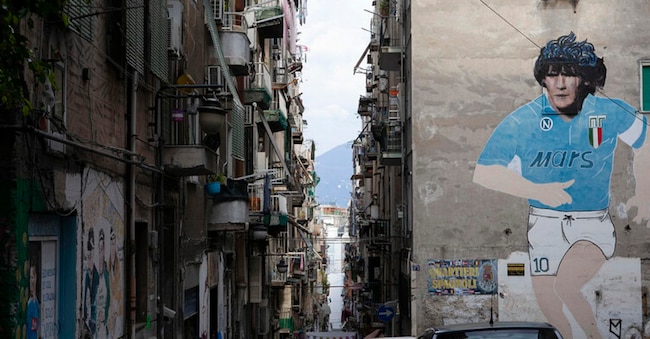
To realise this, one need only go to Via Emanuele de Deo, one of the alleys that crosses the central Via Toledo and climbs towards Corso Vittorio Emanuele, where the mural dedicated to the most famous number 10 in the history of football, who spent the happiest and most prolific seven years of his career in Naples, is located. A work of street art that, according to data collected by travel agencies, last year was (with its six million visitors) the second most visited tourist site in Italy, after the Colosseum and before the ruins of Pompeii.
Unfortunately, or fortunately, there is still no ticket office and, therefore, no empirical evidence of such a performance either. But the economic return for the surrounding area and the induced revenue generated can already be perceived with the naked eye. At least, for the 'in the clear' part, the confirmation comes from the numbers that Unioncamere/Infocamere, with georeferencing work, has drawn up exclusively for Il Sole 24Ore: within a square kilometre of the mural, the stock of economic activities recorded by the business registry has grown by 5.5% compared to 2019, when Maradona was still alive and there had not yet been Covid-19, and by 6.5% compared to 2021, when he had been dead for about a year. These results are in contrast with the rest of the city which, to date, does not yet seem to have put the aftermath of the pandemic behind it and sees total business activity, both compared to 2019 (-0.7%) and to 2021 (-4.5%), in decline despite the renewed tourist allure having produced a surge in hotels, bed and breakfasts, restaurants and pizzerias.
Unlike other murals that have become tourist destinations, the portrait of Dieguito does not owe its fame to its author. It is not, to remain in the Neapolitan capital, the Madonna with a gun that Banksy drew in Piazza dei Gerolomini or one of the many famous faces (including that of Maradona, but in Ponticelli) that Jorit has given to his city. It was made in 1990 by a young local artist, Mauro Filardi, at the instigation of an old capo-ultrà who wanted to celebrate the conquest of the Azzurri's second championship in this way, led on the pitch by the captain with the ten on his shoulders. Two restorations have taken place since then. The first by Salvatore Iodice in 2016, which was to remedy the appearance on the façade, right at the level of the champion's face, of a window that was not there before; the second, entrusted in 2017 to the Argentinean Francisco Bosoletti (author of the veiled Isis on the façade opposite), which served to refresh and update the face of his famous compatriot.
The watershed date for the mural and the entire Spanish Quarter area is 25 November 2020. As soon as the news arrived from Buenos Aires that the Pibe de oro's ailing heart had given out, on the emotional wave of the moment, the little square with his effigy became Diego's tomb for everyone. As much and more than the Jardin Bella Vista in Buenos Aires, where the star player is actually buried. So much so that the space in front of it has abandoned its old name of 'Largo degli artisti' (artists' square), has taken on the new name of 'Largo Maradona' and has become, to all intents and purposes, a pilgrimage destination for thousands and thousands of people: young and old, Italian and foreign tourists, established sportsmen or families with children.


