
Naples: new 277 million dock project put on hold; gas terminal to be relocated
The long-awaited harbour extension has been completed, but the links to the motorway junction are inadequate

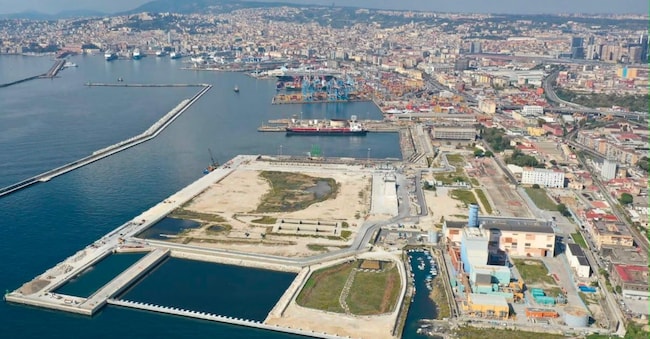
The expansion of the Port of Naples, involving the construction of the Darsena di Levante, has been under discussion for many decades now: it had already been under discussion for some time when, in December 2000, a programme agreement was signed – between the Ministry of Transport and Public Works, the Port Authority, the Harbour Master’s Office, the Campania Region, the City of Naples and the University of Naples Federico II – which designated the Darsena di Levante area as a container terminal. But once again, the project came to a standstill, and many more years passed.
It is worth noting that, under the same programme agreement, the University of Naples Federico II shortly afterwards began construction of the San Giovanni a Teduccio teaching centre, which is celebrating its tenth anniversary this year.
Today, 26 years on, thanks to public investment totalling over 277 million – partly allocated under the NRRP – the Darsena di Levante is now a reality: the terminal covers an area of 248,000 square metres and is protected by a breakwater which, to ensure the stability of the moorings, has been extended by 270 metres and reinforced. The works have been completed and tested; only a small remaining part of the breakwater reinforcement works, funded by the ERDF, is currently underway. However, the new Darsena – unless it is connected to the motorway link via an adequate road network and unless the rail links (also funded by the NRRP) are completed – will remain an island, or, if you prefer, a cathedral in the desert. In any case, it will be unusable for improving the port’s efficiency and handling growing traffic volumes.
What is the obstacle? In order to build the road links, all the pipelines serving the oil depots in East Naples and the gas terminal must be relocated; according to the 2004 amendment to the municipality’s General Urban Development Plan (PRG), these should already have been moved elsewhere. But they are still there.
If brought into operation, the Darsena di Levante will generate a flow of at least 7,000 lorries a day, requiring at least five entry lanes and three exit lanes, with a road carriageway approximately 61.2 metres wide, including the hard shoulders. Furthermore, it is considered that these traffic flows are not compatible with the presence of gas tankers moored right alongside this very road.


