
Naples under scrutiny: environmental, social and technological challenges for the America's Cup
From the critical issues of Bagnoli to the lack of infrastructure, the obstacles to overcome for the city hosting the world's oldest sailing competition

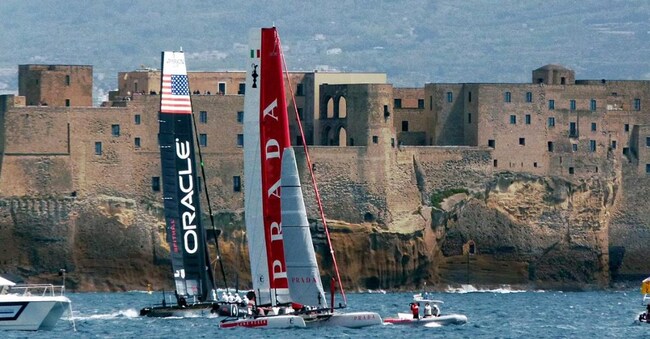
During episode 883 of one of the most popular online talk shows in the United States when it comes to top-level sailing, Sailing Illustrated, hosted by Tom Ehman - a key figure in the America's Cup, former right-hand man of Larry Ellison and protagonist of the unlimited-budget campaigns of Oracle Racing and the Golden Gate Yacht Club - the discussion on the history of the trophy quickly turned into a close analysis of the present and future of the competition. And above all on the delicate challenge represented by its Italian edition in Naples.
The guests were Margherita Marshall (née Bottini) and John Knox Marshall, a couple who have known the America's Cup for over forty years, from different and complementary perspectives. She, a reporter and photographer of the Italian campaigns since the days of Azzurra and Il Moro di Venezia, has closely followed the birth and development of Luna Rossa and worked alongside Vincenzo Onorato on Mascalzone Latino in Valencia. He, an engineer and sailor of the highest level, three times winner of the Cup - once as a crew member and twice as technical manager - is a member of the America's Cup Hall of Fame, an institution that celebrates those who have contributed in an exceptional way to the history of the trophy. Two voices that combine technical expertise, historical memory and independent judgement.
Both members of the New York Yacht Club, the club that has held the Cup for 132 years and forged its tradition, bring a far-reaching vision and credibility that is hard to match. It is also for this reason that what started as a celebratory dialogue turned, during episode 883 of the programme, into an articulate and uncompromising examination of the forthcoming America's Cup in Naples, its criticalities and the opportunities it could offer.
A dialogue that lit a beacon
The first node is Bagnoli. Bottini defines it, without hesitation, very differently from recent chronicles: 'The solution we will see in Naples will be temporary. Bagnoli is a seriously polluted area, with an industrial past that requires huge works. It is a dream that has lasted thirty years'. A direct blow to the heart of the official narrative. The renderings do not erase the reality: land that has not been completely reclaimed, building sites that are advancing slowly, infrastructure still to be built.
Another critical point: the marina that is not there. Bottini recalls a simple but decisive fact for a competition of this level: 'The two historical yacht clubs in Naples are private and those arriving with big boats do not stop in the city. They go to Capri, Sorrento, Procida'. A truth known to those who sail, rarely spoken with such clarity in a public debate.


