
Distilleria Nardini, a constantly evolving model capable of maintaining its identity

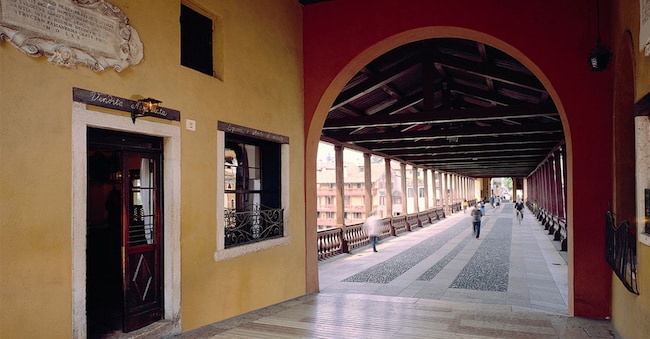
Founded in 1779 by Bortolo Nardini at the entrance to the Ponte Vecchio in Bassano del Grappa, Distilleria Nardini is today the oldest distillery in Italy and one of the few European family businesses that have survived seven generations while maintaining direct management, solidity and strategic continuity.
The original intuition - to transform an itinerant activity into a stable production facility - changed the grappa supply chain and helped define Bassano as a historic centre of distillation in the Veneto region. Since then, the Nardini model has evolved without losing its identity: a balance between technology and craftsmanship that continues to represent a reference point for the sector.
Today, distillation takes place in modern, highly controlled plants, but the heart of the process remains human: every phase, from the selection of the marc to the management of the stills, is supervised by the Master Distiller. Every year, more than 100 thousand quintals of marc are processed for a production of more than one million bottles, including white grappas, reserves and liqueurs.
Grappa Bianca, considered the "pioneer of grappas", and Grappa Riserva continue to be among the most awarded Italian distillates abroad, thanks to quality standards built on three key elements: attention, consistency and control.
This is how Distilleria Nardini continues to strengthen its presence outside Italy, where the brand's traditional products find an ever-growing public. In this context, the role of the National Consortium for the Protection of Grappa remains central: the body monitors the quality, origin and identity of Italian grappa throughout the world and safeguards the IG (Geographical Indication) mark, which guarantees the territoriality of the product and regulates, through strict regulations, all the steps in the production process.
Alongside its historical production, the Distillery has also expanded its portfolio over the years with a line of liqueurs and specialities. These include Acqua di Cedro, which is now growing strongly both on the Italian market and abroad, particularly in North America, thanks to its versatility in both pure and blended form. Also iconic is Mezzo e Mezzo, an aperitif linked to the grapperia on the Bassano Bridge, one of Italy's historic venues, an identity asset that continues to attract visitors and strengthen the Distillery's communicative power. Nardini's latest arrival is Garage Gin, a London Dry Gin born from the creative vision of Garage Nardini, the Distillery's experimental laboratory, made with Italian and local botanicals.
Looking at new markets and categories has not, however, changed the Distillery's guiding principle: a constant commitment to quality and the ability to innovate while remaining true to its identity. Hence also the focus on sustainability, now an integral part of the company vision. Using pomace, in fact, represents a virtuous example in terms of environmental respect and circular economy. After distillation, the pomace also continues its journey. Its components are separated and used in new supply chains: oil rich in antioxidants for food and cosmetic use is extracted from the grape seeds, while the woody part of the latter is used as biomass for renewable energy; the skins, on the other hand, after being dried and ground, become grape marc flour, used in animal feed or as a natural fertiliser. An approach that integrates environmental sustainability and operational efficiency, consistent with the evolutions of the agri-food chain.
With the entry of the eighth generation just around the corner, Nardini continues on a path that combines family continuity, investment and international positioning. A strategy that has allowed the Distilleria to consolidate itself as one of the most long-lived excellences of Made in Italy, capable of maintaining competitiveness without renouncing its cultural heritage.

