
For Unesco sites comes the National Charter of Sustainability
The objective is to guide destinations towards sustainable development models, enhancing cultural heritage, local communities and supply chains
by Enrico Netti
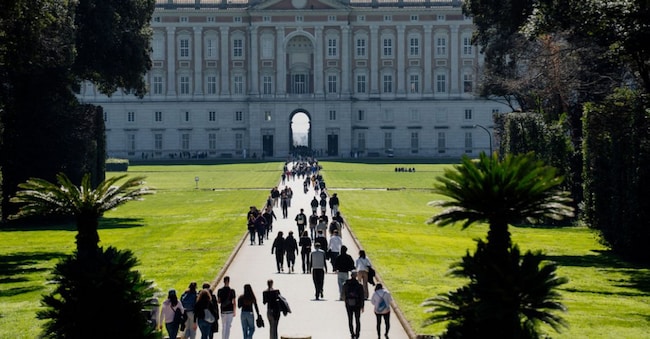
A charter for the sustainability of the areas of the Peninsula that host Unesco heritage sites. The aim is to safeguard the territories and treasures from their own success, safeguarding the overall balance of the territories that host them. This was discussed on Friday in Treviso at the headquarters of the Treviso-Belluno Chamber of Commerce at a meeting organised by the Chamber of Commerce itself and the National Institute for Tourism and Cultural Research (Isnart), as part of the activities envisaged by the 2025/2026 edition of the Mirabilia Special Project, promoted by 22 Italian Chambers of Commerce together with Unioncamere.
With this objective in mind, the National Charter for the Sustainability of Destinations Hosting a Unesco Site was presented, a tool developed by Isnart to guide destinations towards sustainable development models, enhancing cultural heritage, local communities and supply chain systems and acting as a coordination framework for the alignment of territorial sustainability policies with Unesco principles and guidelines, with the aim of providing shared tools to analyse, monitor and improve the sustainability of tourist destinations. The Mirabilia project involves almost 600 municipalities and 24 Unesco sites that, while representing about 7% of Italian municipalities, generate 19% of national tourist presences according to data from the Tagliacarne Study Centre.
"When we presented the Sustainability Charter of Cison di Valmarino in 2022," said Mario Pozza, president of the Chamber of Commerce of Treviso-Belluno-Dolomiti, "we were convinced that that document could become a shared model. In fact, we also presented it at European level, to Ambassador Francesco Genuardi of the Italian Embassy in Brussels. Today, a few years later, that intuition has found confirmation in the common path of the entire Mirabilia network and now takes shape in a National Charter that synthesises what we have built together. It is a deep satisfaction to see that what started from our territory has fuelled a choral work capable of offering the Italian Chambers of Commerce common guidelines to read and govern the sustainable tourism development of the Unesco sites of which we are custodians. We are convinced that there is no lasting growth without the ability to take care of the extraordinary territories that the Mirabilia network represents
The Charter is proposed as a real 'toolbox' for Chambers of Commerce, administrations and economic operators that is based on a model centred on the three fundamental dimensions of sustainability - environmental, economic, social - to which the cultural dimension has been added, which becomes fundamental when sustainability is applied to territories that are home to heritage recognised by Unesco. Special attention is devoted to territorial governance, which must work in an integrated way, analysed through indicators that allow monitoring aspects such as tourism pressure, land consumption, environmental quality, employment, vitality of cultural enterprises, accessibility, social inclusion and visitor perception. The Charter also outlines a path for progressive improvement, based on the sharing of data, tools and good practices. In this context, a central role is entrusted to the Chambers of Commerce of the Mirabilia Special Project, called upon to foster territorial coordination, dialogue between institutions and enterprises and the dissemination of a possible model capable of concretely reconciling development that brings wellbeing to the territories and protection that allows the preservation of assets, also with future generations in mind.
There is an attempt to govern, to manage cultural tourism, which is seen as growing steadily. Isnart data show that culture is for the fourth consecutive year the first motivation for foreigners to visit our country and alone moves 45% of international visitors, while in Unesco sites the increase between 2024 and 2023 of visitors is 14.87%, according to Unitelma Sapienza data from Rome. However, growth must be guided: villages and hinterland areas are becoming an active part of the tourist offer, and then overtourism, climate change, urban pressure and depopulation of inland areas impose a new approach: building sustainable tourism development models capable of enhancing heritage, reconciling it with the quality of life of resident communities and the identity of places.

