
Defence, NATO and the EU argue over the 'wall of drones'. Here's why
For Brussels, the initiative is part of a broader project, the Eastern Flank Watch, a 'flagship defence project aimed at protecting the entire European Union' that will have a 'land' component (e.g. anti-tank trenches), 'maritime security for the Baltic and Black Seas' and 'space measures'. But the Atlantic Alliance warns: 'The competence is ours'

Key points
A tug-of-war between the European Union and NATO over the anti-drone wall project is increasingly taking shape. A dossier that is on the table at the meeting of EU defence ministers on Wednesday 15 October, among other things after a stop at NATO for the Alliance's ministerial meeting. The next day, Thursday 16, European Commission President Ursula von der Leyen will lay her cards on the table and present the EU's road map for defence. And here too the topic will have its place. Finally, the defence solution will be on the agenda of the European Council on 23 October in Brussels.
The dossier
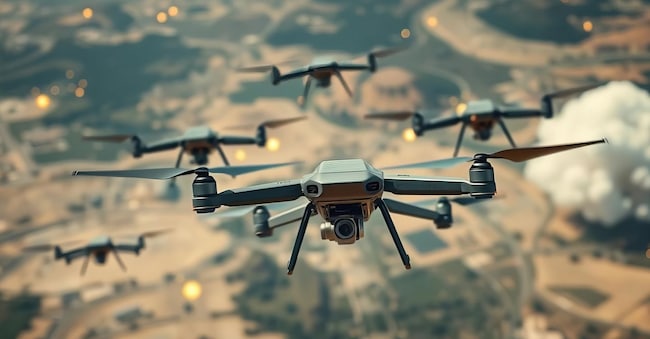
The complexity stems from the fact that, apart from not being easy to realise, this project goes directly to the heart of the defence relationship between the EU and NATO, and that there is a risk of overlapping and increased costs. The 'wall of drones' is in fact a pilot project on which the European Commission wants to work immediately with the cooperation (and know-how) of Ukraine. The solution was proposed by Brussels after some 20 Russian drones entered the airspace of EU and NATO member Poland last month.
According to Defence Commissioner Andrius Kubilius the anti-drone wall is part of a larger project, the Eastern Flank Watch, a "flagship defence project aimed at protecting the entire European Union" that will have a "land" component (e.g. anti-tank trenches), "maritime security for the Baltic and Black Seas" and "space measures". "Hybrid attacks and drone sightings in the vicinity of our critical infrastructure, as well as hostile incursions into the airspace of member states, are further proof of the urgency to accelerate work to achieve common European defence readiness by 2030," recalled European Council President Antonio Costa.
The system, as conceived, has been compared to more complex missile defence systems, such as Israel's Iron Dome, but is adapted to counter smaller, cheaper and more widespread UAVs (an acronym for Unmanned Aerial Vehicle, which in Italian means 'unmanned aerial vehicle' or 'remotely piloted aircraft').
For the EU this is, in fact, Moscow's new hybrid warfare frontier. 'On Thursday the Commission will approve our defence readiness roadmap, which we will present to the Council at the end of October,' Kubilius clarified.


