
NATO: 'Italian ship monitors a Russian submarine in the Mediterranean'. It's the frigate Fasan: that's why it's there
Fasan is flagship of Operation Standing NATO Maritime Group 2

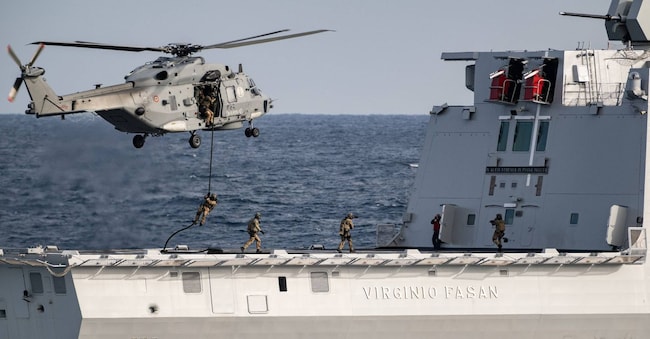
"The Italian ship of the Standing Nato Maritime Group 2, the Its Virginio Fasan, is monitoring and tracking in the Mediterranean Sea the Russian Kilo Krasnodar class submarine, with escorts including the Russian destroyer Severomorsk." This was reported on X by the Atlantic Alliance's Maritime Command, highlighting that the Italian activity demonstrates "the allies' vigilance, situational awareness and commitment to safety at sea".
The Fasan frigate
Nave Virginio Fasan (F 591) referred to by the Atlantic Alliance is the second of the FREMM (European Multi-Mission Frigates) class frigates and the first in ASW (Anti Submarine Warfare) configuration. The unit, built at Fincantieri's Riva Trigoso shipyard, was launched on 31 March 2012 and then transported to the Muggiano shipyard for the completion of outfitting and testing. Nave Virginio Fasan was delivered to the Navy on 19 December 2013. The ship is currently based in the port of La Spezia and is employed by the 1st Naval Division.
After being engaged in Operation Safe Mediterranean after the Israeli-Palestinian crisis, it was sent to the Red Sea in December 2023 to protect merchant ships from Houthi attacks. In April 2024, it shot down a drone near the Bab El Mandeb Strait while escorting a merchant ship as part of Operation Aspides. The drone, with similar characteristics to those used in previous attacks by Yemeni rebels, was about 5 kilometres away from the Italian ship. That was the first direct intervention against a UAV (Unmanned Aerial Vehicles), i.e. a remotely piloted aircraft. In September last year, Fasan followed the Flotilla closely to provide rescue and assistance if necessary.
Now the Fasan is flagship of Operation Standing NATO Maritime Group 2.
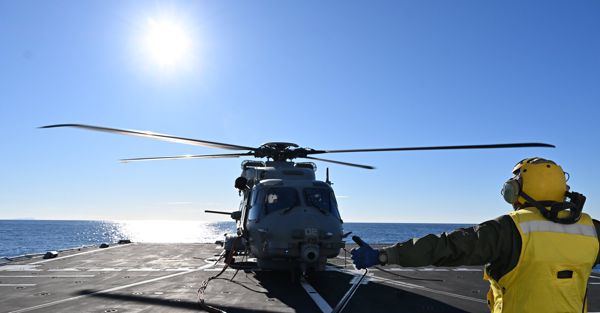
NATO's naval force
TheStanding NATO Maritime Group 2 is one of NATO's four standing naval forces, consisting of an integrated multinational group of ships belonging to different allied nations. It operates mainly in the Mediterranean and Black Seas, monitoring vital lines of communication between Europe, the Middle East and North Africa. Together with the Standing NATO Maritime Group 1, focused on the North Atlantic, it represents the backbone of the NATO Response Force's maritime capability. The activities are part of the broader concept of 'Cooperative Security' (one of the three pillars of the Alliance) and enable the development of dialogue and cooperation with NATO's Mediterranean partner navies, which are crucial for enhancing regional maritime security and preventing potential crises.


