
Natural gas has never been in such demand, and Asia is leading the way

4' min read
4' min read
Global demand for natural gas increased by 2.7 per cent in 2024, reaching a new all-time high, according to the International Energy Agency. Between 2019 and 2023, the increase had been much smaller, averaging around 1%, due to the post-Covid energy crisis and the price spike linked to the Russian invasion of Ukraine. Then the markets started to rebalance, thanks to targeted policy interventions and greater availability for liquefied natural gas (LNG) exports.
The growth in demand affected all energy sources: renewables and nuclear covered almost half of the total, while natural gas accounted for 28%. The other fossil fuels, however, showed signs of slowing down. Demand for oil rose by 0.8%, down sharply from last year's +1.9%. Coal, which has been steadily slowing down since 2021, also showed a modest increase (+1.2%). The current picture is in line with forecasts by the International Energy Agency, according to which the consumption of fossil fuels will peak by 2030, and then decline thanks to the spread of clean technologies.
Natural gas, a bridge to decarbonisation
Of the fossil fuels, natural gas is the one with the lowest environmental impact: for the same amount of energy generated, it produces about 40% less CO₂ emissions than coal and about 20% less than oil. There are also benefits for air quality, because it releases minimal quantities of fine particulate matter (PM 2.5), while sulphur oxides are almost completely removed before use. Instead, it produces nitrogen oxides, the other main air pollutant, but is responsible for only 10 per cent of energy-related emissions of this type.
With the green transition proceeding gradually, natural gas is a useful transition fuel, offering a fast way to accelerate decarbonisation. It is estimated that substituting it for coal in existing plants could reduce emissions related to electricity and heat production by 10 per cent.
Asia's gas demand grows, but energy sector needs stability
Global gas imports are shifting to Asian markets, a trend set to grow according to energy research group Wood Mackenzie: on the continent, demand for liquefied natural gas is expected to nearly double by 2050. In the next ten years it will be China that will drive imports, and then decline thanks to new pipelines coming on stream. After 2030, it will be the turn of South and South-East Asian countries, driven by industrial development, but also by the need to reduce the use of coal, which remains the region's main energy source.
South-East Asian markets have historically been vulnerable to fluctuations in gas prices: when costs rose, countries quickly reverted to more polluting fossil sources. Wood Mackenzie predicts that there will be a growing imbalance between global supply and demand for liquefied natural gas after 2030. South-East Asia, in particular, is expected to become a net importer already in the coming years, also due to the depletion of local fields. The development of new production capacities, capable of ensuring sufficient supplies at competitive prices, will be decisive for the stability of the region's energy sector, as well as for achieving climate goals.
Eni in South-East Asia, between local partnerships and sustainability
While demand for gas is growing rapidly in the Asia-Pacific region, Eni is consolidating its presence in the region through a long-term strategy, in line with the group's goal of increasing this source to 60% of upstream activities by 2030. Southeast Asia, where energy demand is increasingly shifting towards natural gas and governments are committed to reducing emissions, offers ideal conditions for developing efficient and sustainable projects.
Eni's strategy is articulated on four fronts: exploration activities, which have already yielded significant results; the rapid and low-cost development of new projects, with a focus on environmental impact and the reuse of existing infrastructure; partnerships with local operators, to implement targeted initiatives rooted in the territory; and finally, green projects, which include CO₂ capture and storage and the production of biofuels, to achieve the decarbonisation targets set by the countries of the region.
Indonesia and Malaysia at the heart of operations in Asia-Pacific
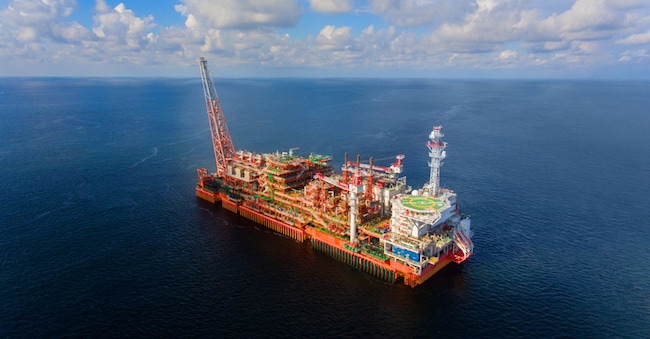
In Indonesia, where Eni has been present since 2001, the group has concentrated its activities in the Kutei Basin, through targeted acquisitions and solid geological knowledge of the region. In this area, Eni has developed two strategic hubs. The southern one, already fully operational through the Jangkrik floating platform, operates on the field of the same name and on the Merakes and Merakes East fields. Current production levels will remain sustained over the long term thanks to new resources identified in the area. The discovery of the Geng North field in 2023 made it possible to start development of a second pole in the north of the Kutei Basin, which will reach significant volumes in the next few years and will unlock further exploration opportunities. Overall, Eni is expected to achieve sufficient production in a few years to cover demand in the region and enable exports to neighbouring markets.
Indonesia is at the heart of the new partnership between Eni and the Malaysian energy company Petronas: the two companies are setting up a business combination, i.e. a new self-financed company into which the Indonesian assets of Eni and Petronas will be merged to form an energy hub in South-East Asia. An area of great strategic importance and potential in natural gas production. The operations will initially focus on Indonesia, but may in the future expand to the surrounding area, which is rich in opportunities yet to be explored. The business combination will be assigned assets that are already producing by the two partner companies, and can thus be immediately operational so as to become a major player in the region in a short time.

