
Boating, Emilia-Romagna accelerates: 1.6 billion euro district focusing on premium and luxury
Between Rimini, Ravenna and Forlì-Cesena an integrated nautical cluster is consolidated with 287 companies and 3,600 employees. Exports over 800 million and an enlarged supply chain with up to 12 thousand employees

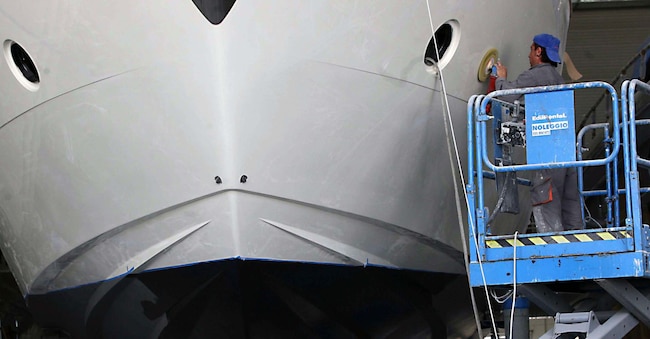
There is a stretch of the Adriatic where the boating industry is not just an industry, but an integrated production system, capable of competing at global heights. It is here, between Rimini, Ravenna, and Forlì-Cesena, that Emilia-Romagna consolidates its role as one of the main poles of the Italian pleasure boating industry, with figures that tell of structural growth and an increasingly marked specialisation towards the top of the range. The figures presented in Bologna, on the occasion of the first regional round table on the boating industry, speak of 287 companies and over 3,600 employees, for a total turnover of 1.6 billion Euro, about half of which is generated on foreign markets.
Numbers emerging from the study "The boating sector in Emilia-Romagna", carried out by Art-ER together with the University of Bologna and Ser.In.Ar. A dimension that places the region among the national protagonists of a sector in which Italia confirms its position as world leader in the export of motorised pleasure craft, with a 24.1% share.
The production heart beats in Romagna, where 80% of employment and 90% of turnover are concentrated. This is where the big players that drive the entire supply chain operate: above all the Ferretti group, flanked by the Bologna-based Cantiere del Pardo, Absolute, Solaris Power and Quick. It is a highly concentrated system, in which the main companies generate about 90% of overall revenues, with Ferretti alone accounting for over 70%.
But alongside the large construction sites there is a widespread network of small and medium-sized specialised companies, which guarantee skills, flexibility and quality, helping to make the entire ecosystem competitive. "The regional table can become a laboratory of industrial policies in which actions are defined to orchestrate an innovative evolution of the entire supply chain," emphasises the Region's vice-president, Vincenzo Colla. "A yacht is a system, not a product: value comes from the ability to perfectly integrate design, technologies and customisation."
It is precisely this capacity for integration that explains the growth trajectory of recent years. In the last decade, turnover and exports have more than tripled, while employment has increased by 60%, a sign of solid international demand and competitive positioning based on quality, design and innovation. Today, exports exceed EUR 800 million, with the United States, France and the United Kingdom accounting for more than half of foreign sales.

