
Navy Chief of Staff Bergotto warns: 'The defence of Hormuz is not zero risk'
The Admiral spoke on the policies of his mandate before the Senate Foreign Affairs and Defence Committee: "Personnel is the problem because the sailor has a sacrificed life and above all has a life that does not allow the modern young person to use social media"

Key points
- Navy Chief of Staff Bergotto: "Zero risk on a possible escort on Hormuz I don't have it"
- "For us, personnel is the problem"
- "We lose so many people, they also prefer to go to the prison police"
- "In the Mediterranean, the security of critical submarine infrastructure must be sought"
- "Threats change all the time"
- The experience of the EU Aspides mission and the costs of bringing down drones
- The Times of Procurement
Italia along with the UK, France, Germany, the Netherlands and Japan denounced the attacks on commercial ships in the Persian Gulf and the de facto closure of the Strait of Hormuz by Iran. The six governments agreed to contribute to efforts to ensure safe passage through the area. "No war mission," clarified Defence Minister Guido Crosetto, "no entry into Hormuz without a truce and without an extended multilateral initiative. We are aware, however, of the importance for everyone to work for the safe reopening of Hormuz and we believe that it is right and proper that the United Nations provides the legal framework for a peaceful and multilateral initiative to achieve this goal'.
Navy Chief of Staff Bergotto: "Zero risk on a possible escort on Hormuz I don't have it"
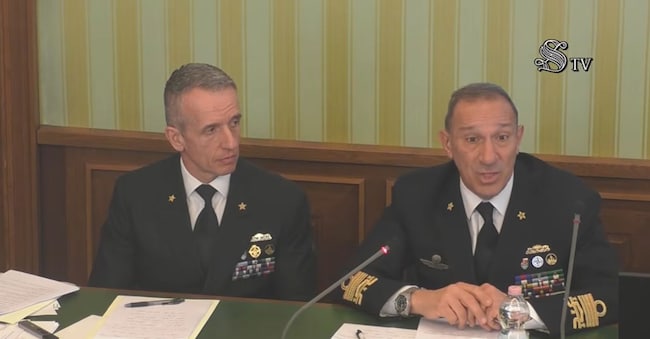
Now the Navy's Chief of Staff, Admiral Giuseppe Berutti Bergotto, speaking on Wednesday 25 March in a hearing before the Senate's Foreign Affairs and Defence Committee, reiterates that a possible operation in those waters would have its risks. "Hormuz is very peculiar," he said, "but like all straits: 33 kilometres, of these 33 kilometres think that there are two channels like a motorway, two ways, one going up and one going out. Such an area is easily blocked even with a handheld weapon. Think of the Rpg (Rocket Propelled Grenade, portable anti-tank weapons designed to penetrate the armour of vehicles, ed): one goes out with a six-metre boat, an engine approaches, so the defence of Hormuz is not simple, it's not simple at all, even if we manage to eliminate the missile threat there is an even simpler threat. That's why the defence of Hormuz is absolutely not a zero-risk thing. We are capable, we have the ships that allow us, but you see (the Admiral is responding to a question posed by a senator, ed.) even those surface drones can help to try to interact with the threat as far away as possible, but I have no zero risk on a possible escort on Hormuz, which I have instead in the Red Sea, because that with greater distances, with the ease of seeing if someone actually goes out with a boat and be able to intervene on Hormuz given the distances I do not have it.
"For us, personnel is the problem"
The Admiral also addressed the personnel issue. "For us," he emphasised in his speech, "it is a problem and since the beginning of my mandate I always say: 'The Navy is technologically advanced, from an industrial point of view I can have products that are up-to-date and usable at all times'. But personnel is the problem: it is the problem because the sailor has a sacrificed life and above all he has a life that does not allow the modern young person to use social media. You may not believe it, but one of the biggest problems for our young people is not being able to use social media; from the other point of view,' Berutti Bergotto continued, 'they are 'sponges', they want to learn, they want to know, and they want to do jobs that they consider important, so what we used to do in the past, i.e. when the sailor came and we put him in the mess, we put him to clean the squares, we put him to wash the shanks, we cannot do that any more, so what we are doing is a lot of initiatives, not only for enlistment but especially for retention.
"We lose so many people, they prefer to go to the prison police too"
"The Navy, but not only the Navy, also the other armed forces," continued the admiral, "are seen as a bridge (bridge, ed.) that gives these young people skills to then go on to the competitions: Carabinieri, Guardia di Finanza, Police, Prison Police. We also lose many people to go to the Prison Police. And if a 20-year-old girl goes to the Prison Police it is a problem, it means that we are not able to give what they expect to stay, it is a challenge, we are facing it'.
"In the Mediterranean, the security of critical submarine infrastructure must be sought"
One passage of the Navy Chief of Staff's speech was on security below sea level. 'Until some time ago,' he recalled, 'all nations put critical infrastructure on the seabed without any protection, because it was imagined that a depth in itself gave inherent security. That is no longer the case. Nowadays, 3,000 metres are easily accessible to everyone, both state and non-state actors, and at a low price. If you think that the Mediterranean is a relatively shallow sea, only 15 per cent is deeper than 3,000 metres, this makes you realise that it is a sea where the security of critical submarine infrastructures must be sought'


