
Navee NT5 Max: an SUV on two wheels. How does this XL-sized scooter ride and what’s it like?
A powerful engine, a sturdy chassis, effective suspension, 10.5-inch wheels and dual disc brakes make it a vehicle that can handle the urban jungle and rough terrain, but due to its size, it is difficult to lift and transport: this is the downside of having a safe vehicle

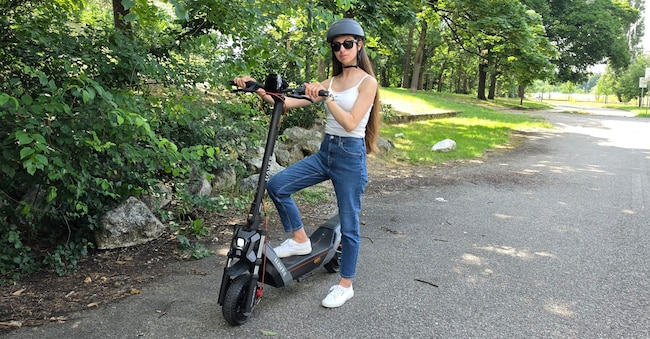
With its XL size, it’s practically an SUV of the e-scooter world. The new Navee NT5 Max is quite a unique piece of kit: finished and built as if it were a motorbike, it boasts high-quality features, a very robust build and excellent performance in terms of comfort, range, handling and safety – although safety remains a critical issue for all e-scooters. But here we’re looking at a dual disc brake system with two large levers, much like those on a scooter, as well as electronic traction control systems.
From the very first glance, it’s clear that this is a luxury scooter – after all, it costs 700 euros: just look at the control panels, which feature large, sturdy buttons that are easy to spot; here too, it feels more like you’re looking at a moped than a scooter. There are, of course, the indicator controls, as required by law, and there is an easily recognisable red lever that activates the boost – a surge of power that comes in handy for getting out of tricky situations.
The build is decidedly robust, with a frame comprising trusses that are considerably larger than even the average for top-of-the-range scooters. A small detail: the screws securing the handlebars to the steering column are generously sized – much larger than usual – and, crucially, can be tightened securely. As a result, even on rough terrain, the ride feels extremely solid and, thanks also to the excellent suspension fitted to this Navee NT5 Max, you can tackle even challenging terrain with confidence. Indeed, this further demonstrates that it is a high-end electric scooter designed to tackle both the most uneven urban routes (Milan’s pavements are a prime example) and light off-road terrain. Riding comfort is ensured by a dual-suspension system, featuring a telescopic fork at the front and a shock-absorbing arm at the rear, developed to effectively absorb potholes, cobblestones and any unevenness in the road surface. Grip is ensured by 10.5-inch tubeless tyres with an increased 80 mm contact patch, whilst braking safety is provided by twin 140 mm discs fitted to both wheels. The TCS (Traction Control System) is particularly useful: this active traction control system prevents the rear wheel from slipping on slippery or wet surfaces.
The Navee NT 5 GT boasts a motor with a rated power of 500 W (meaning it complies with current regulations and delivers a maximum peak power of 1,600 W), capable of tackling gradients of up to 28 per cent. It is precisely this ability to tackle fairly steep climbs that makes it a viable option for both urban and rural use. The 46.8 V, 561.6 Wh battery ensures a claimed range of up to 85 km at low speeds (around 15 km/h). In real-world, everyday use at urban speeds, the range settles at around 50–60 km. A full recharge takes approximately 5–6 hours. In practice, however, using it almost exclusively in sport mode – which allows us to get out of tricky situations – you can easily cover around forty kilometres. And when you’re standing on a scooter, that really is a long way.
The Navee NT5 Max is therefore a sturdy and stable vehicle, but it is precisely because of its size and sturdiness that it has its main limitation: it is difficult to transport as it weighs 33.5 kg; fitting it into a boot is certainly not very convenient, and it certainly cannot be used for multimodal commuting – that is, taking it to a metro station and boarding with it. This is not feasible because the Navee is designed for something entirely different.


