
Nelio Biedermann and the luxury of not being a contemporary
At the 27th edition of Pordenonelegge, we met the very young author of *I Lázár*, which – just a few days after its release in Italia – is already one of the best-selling books


The first thing to do when it comes to Nelio Biedermann is to stop talking about his age. It’s difficult, because that is exactly what the publishing industry and the newspapers have decided to do. Twenty-three years old, a 300-page novel, a Hungarian aristocratic family, the collapse of the Austro-Hungarian Empire, two world wars, persecution, communism and Stalin. It almost seems like a joke about the relationship between chronological age and literary ambition. Then you read *I Lázár*, published in Italia by Guanda – a book that is, to say the least, gripping – and the joke is over. The truly surprising thing is not that a young man in his early twenties has written a family saga, but that he had the idea – seemingly out of fashion – that a family saga can still be a contemporary form. Biedermann, in fact, does not turn to the present simply because he is young, but turns to the twentieth century because – as he explained to us during our meeting at the 27th edition of Pordenonelegge – ‘it has not yet finished producing consequences’. That is a substantial difference. The novel became an international sensation even before it reached Italia: published in German-speaking countries in 2025, it is currently being translated into over twenty languages, was a finalist for the Schweizer Buchpreis and has received the Independent Booksellers’ Prize.
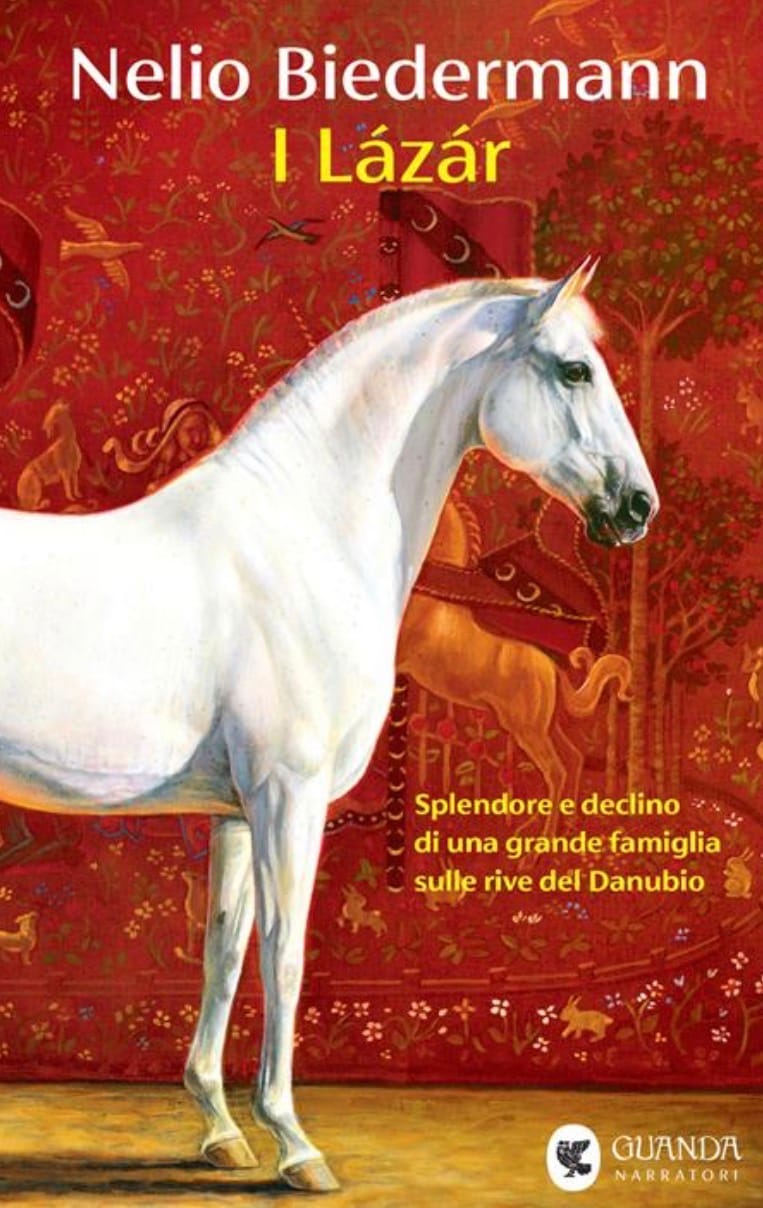
In short, the market immediately recognised something that ought to be normal but which today seems almost eccentric: the fact that this young man knows how to tell a story. The history of young prodigies is full of pitfalls. Françoise Sagan was eighteen when, in 1954, *Bonjour tristesse* was published and her name became instantly inextricably linked with that of the novel. Mary Shelley was twenty when *Frankenstein* was published in 1818, having begun writing it at eighteen. In both cases, her age seemed to explain the phenomenon but actually complicated it, because the public always saw her first and foremost as a girl rather than a writer. Biedermann risks the same fate, with an added complication, because we are living in a historical moment in which the publishing industry has learnt to turn age into a commercial category. It is no longer enough to say that a book is good; one must specify which generation it comes from, which community it belongs to, which identity it represents and which pressing issue it addresses. Biedermann throws this whole system slightly off balance: she is young, but her novel is not; on the contrary, it is deliberately old-fashioned, just as old-fashioned as its form—with the family, the genealogical secret, the castle, blood, marriage, inheritance and ruin. Even the pleasure of telling stories about people who have no intention of being representative is old-fashioned. The Lázárs, in fact, are not meant to represent Gen Z, nor Europe, nor any contemporary sensibility; they are meant to live, desire, betray and die. Then, without having planned it, they become History. Biedermann does not bring History into the novel, but the novel into History. The twentieth century does not arrive in the form of an explanation, but as a change in the material conditions of existence. A border shifts and someone loses their home; a regime changes and a person’s name changes; an army crosses a territory and a family ceases to be what it once was. The aristocracy, moreover, is not used to embalm the past, but serves to show just how fragile any claim to continuity is. A surname ought to be the most stable thing in the world, but in the novel it is almost a suspect object. Genealogy is supposed to establish who we are, but in the book it serves above all to demonstrate that we never know this fully. Perhaps this is why Biedermann looks to the past rather than the present. ‘The present is difficult to describe because we do not know what comes next; the past, on the other hand, has already produced its consequences,’ he explained to us. The novelist, therefore, is not necessarily the one who predicts the future, but the one who knows how to wait long enough to see the consequences. In an age like this, dominated by an obsession with prediction through algorithms, data, models, artificial intelligence and the anticipation of behaviour, there is Nelio Biedermann: an author born in 2003 who has made a name for himself with a novel that rejects almost everything that should make an author born in that year recognisable. He does not recount his generational bubble, he does not seek immediacy, he does not turn the novel into an extension of his own biography, but takes a fictional family and bestows upon it half a century of history. In the end, his youth remains merely a news item and *I Lázár* a true literary sensation, but the ‘Biedermann phenomenon’ begins when it ceases to seem like one and he is reduced to being just a young man. He, who has grasped a rather age-old truth: that to tell the story of one’s own time, sometimes, one must have the courage to tell the story of another.

