Asia

Flooding in Nepal and Tibet: three Italians among the 1,500 missing. 359 bodies recovered

The Italian Ministry of Foreign Affairs is verifying the information provided by the National Tourism Board in Kathmandu

from our correspondent Marco Masciaga

aggiornato alle 20:20

Aggiungi Il Sole 24 Ore
ai preferiti su Google
Giornalista dell'Ansa in Nepal: "Situazione complicata già da giorni"

4' min read

Translated by AI
Versione italiana

4' min read

Translated by AI
Versione italiana

NEW DELHI – It is believed that three Italians are among those missing following the devastating flood that struck the Himalayan regions on the border between Nepal and Tibet on Wednesday. The authorities in Kathmandu have recovered 356 bodies and have lost contact with 910 people, including 517 foreigners; whilst in Tibet – where a landslide in the Gyirong area swept away a border post – the Chinese government’s official figures put the death toll at just three, but as many as 558 people are missing, including 260 foreigners. Roads, bridges and power stations have been destroyed.

Sources at the Ministry of Foreign Affairs have indicated that investigations are underway regarding the three Italians whom the Nepalese authorities have been unable to trace. The Farnesina states that, of the ten or so Italians who were still unaccounted for this morning, there are now three specific cases that have been reported. The first is Marco Ratto, who was travelling from Nepal to Tibet. The Chinese travel agency that was due to take charge of the group has confirmed that it lost contact with them at the border crossing. This information has also been confirmed by the Nepalese agency directly to the family. Then there is an Italian-Swiss couple travelling from Tibet to Nepal. The Farnesina explains that there are no details of the travel agency and there is still no confirmation that they have crossed the border.
Loading...

The Ministry of Foreign Affairs reports that the figures released by the Nepalese authorities are based on information provided by tour operators and may be inaccurate and fail to take into account those who have not crossed the border. Among the 27 foreign tourists rescued so far in the Timure and Bhote Koshi areas, in the Rasuwa district, there are also two Italians: Valentina Piccinini and Stefano Lotumolo. This is reported by Nepal News, citing the National Disaster Risk Reduction and Management Authority (NDRRMA).

In total, nearly 1,500 people of 30 nationalities have not been heard from since yesterday, when the break-off of a large section of a glacier sent an enormous quantity of ice, rocks and debris, causing a flood that swept away bridges, villages and hydroelectric power stations.

Meanwhile, in China, a natural dammed lake formed following a landslide in Gyirong County, in Tibet, is causing concern. The Chinese authorities have stepped up monitoring of the reservoir due to the risk that it could fail or that the water could overflow, causing further flooding in the downstream areas on Nepalese territory.

Inondazioni in Nepal, i soccorsi tra le case sommerse dal fango
In Nepal violente inondazioni, morti e dispersi

The cause of the floods in Nepal and Tibet

Initially, the flooding in the Rasuwa district of Nepal was attributed to an avalanche triggered by an earthquake that struck on Wednesday morning in Tibet. However, a subsequent analysis by the US Geological Survey (USGS) established that no earthquake had occurred prior to the break-off of a section of glacier on the border between Nepal and Tibet, which triggered the tragedy. ‘This event was initially reported as a magnitude 4.4 earthquake,’ reads the update on the USGS website, ‘but further analysis of long-period seismic waves indicates that the seismic energy was instead generated by a landslide.’

The Himalayan region is particularly prone to heavy rainfall, flooding and landslides because it is warming more rapidly than the rest of the world as a result of climate change. Research shows that in this part of the world, extreme weather events – including heatwaves and exceptional rainfall, as well as glacier melt – have become more frequent.

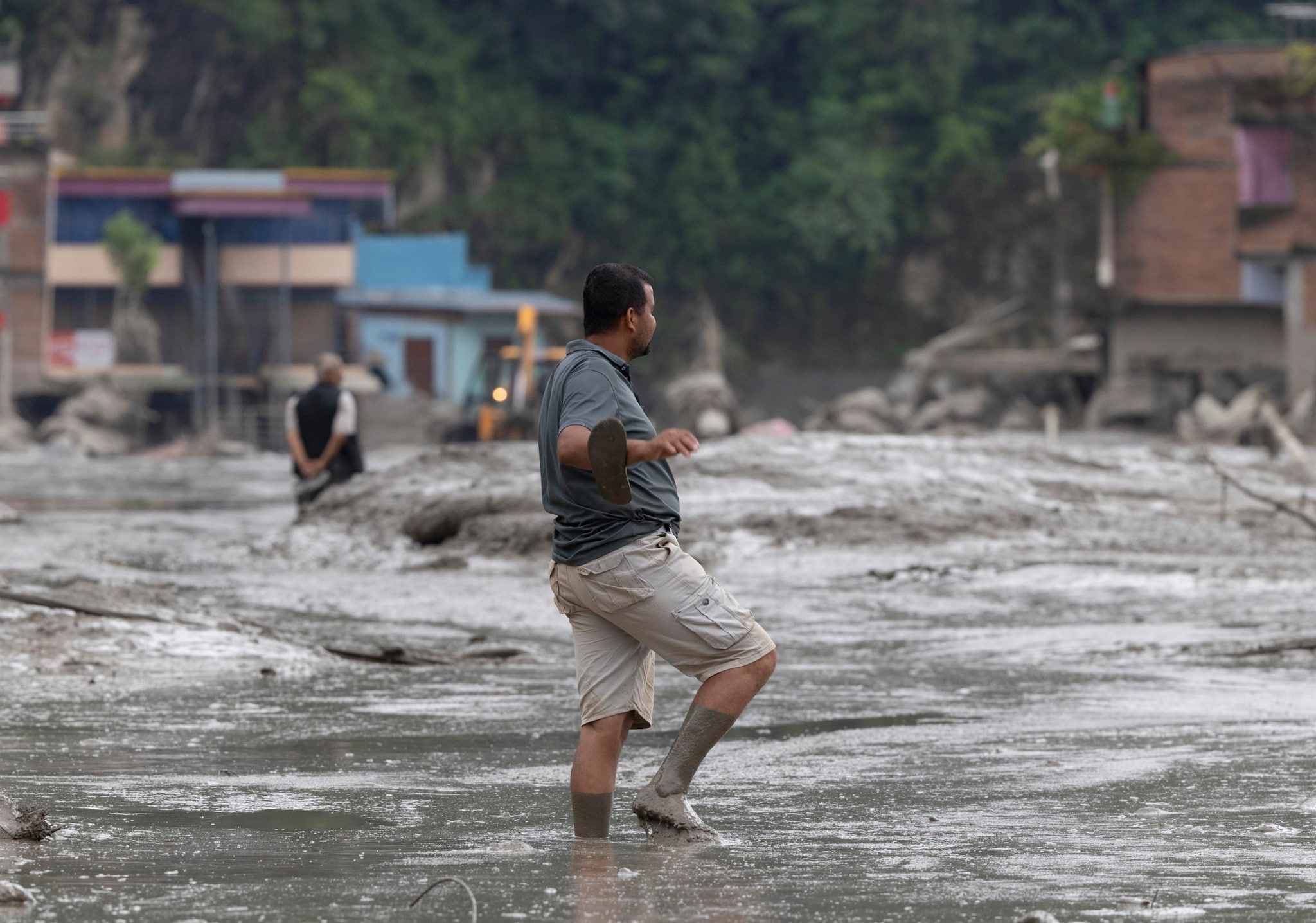
Le acque alluvionali travolgono Trishuli Bazar in seguito a un'inondazione improvvisa, nel distretto di Nuwakot, in Nepal, il 26 agosto 2026. EPA/NARENDRA SHRESTHA

Footage broadcast on TV channels showed collapsed houses being swept away by the floodwaters, cars adrift and a massive metal structure on the Trishuli River swept away by the flood. According to some witnesses, entire villages were reportedly submerged by the floodwaters. Others claim to have seen the current sweep away ‘eight or nine lorries, along with houses and people’.

“There is devastation wherever we look,” explains Tula Bahadur BK, a healthcare worker from Rasuwa. “The settlements near the river have been completely swept away. Five of my relatives are missing.” According to the Nepalese army spokesperson Raja Ram Basnet, rescue helicopters will not be able to land in the affected areas until the waters recede.

The international response

Chinese President Xi Jinping – who, in recognition of the gravity of the situation, has sent Premier Li Qiang to the scene of the disaster – has called for every possible effort to be made to search for and rescue those missing, to evacuate and rehouse residents threatened by the disaster, and to speed up treatment for the injured, with the aim of minimising the number of casualties. He also ordered that monitoring and early warning systems be strengthened, that rescue operations be carried out in accordance with scientific principles, and that the occurrence of secondary disasters be prevented.

Loading...

On Thursday, the first pledges of aid arrived for Nepal, a country that ranks 45th out of 50 in Asia in terms of per capita income. The United Kingdom has allocated £5 million in aid; the United States, with an economy eight times larger than the UK’s, has pledged $500,000 – less than a thirteenth of that amount.

Two Italians’ account: stuck on a bus for 8 hours

“We were stuck on the bus for eight hours. No one had any news until the first reports and videos began to circulate.” This is the account given on Tg1 by Giovanni Fassini and Marco Lombardi, two Italians who were stranded on a bus heading for Kathmandu airport whilst floods were sweeping through Nepal.

The two were coming to the end of their holiday and were due to catch a flight to Milan. “The bus stopped because the road was blocked, and at first we didn’t understand why. Eventually, we realised that the river beside us was rising, rising and rising. Fortunately, it didn’t reach our vehicle”, they said.

Copyright reserved ©
Loading...

Brand connect

Loading...

Newsletter

Notizie e approfondimenti sugli avvenimenti politici, economici e finanziari.

Iscriviti