Companies

Nestlé: over 15,000 attendees at ReNest – food inspires a manifesto for more mindful consumption

by Fabrizio Arnhold

3' min read

Translated by AI
Versione italiana

3' min read

Translated by AI
Versione italiana

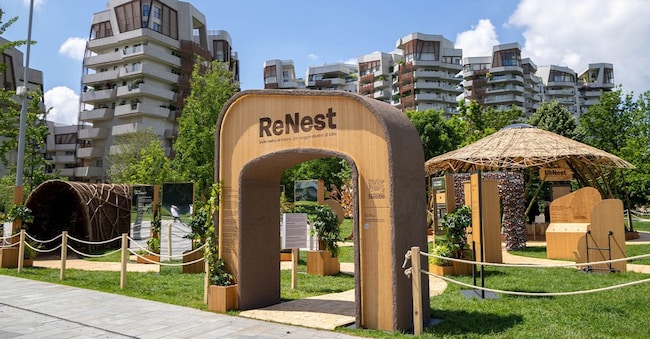
Over 15,000 attendees, more than 40 panel discussions, 120 guided tours and over 50 on-stage presentations. These are the figures as ReNest draws to a close. From roots to the future. A journey into food, the project promoted by the Nestlé Group in Italia, under the patronage of the City of Milan and Assolombarda, which from 12 to 24 May transformed Piazza Elsa Morante, at CityLife, into an experiential space dedicated to the future of food.

The initiative brought often complex issues such as sustainability, food waste, regenerative agriculture, supply chains and circularity to the heart of the city, seeking to explain them in accessible terms through interactive installations, workshops, cookery demonstrations, meetings and discussions with members of the public, experts, businesses and institutions. At the heart of the initiative was ‘Il Nido’ – a nod to Nestlé’s historic symbol – designed as a space for listening and participation to foster greater awareness of the value of food.

Loading...

From the event to the poster

However, the conclusion of the initiative is not the end of the story. ReNest has in fact given rise to the ‘ReNest Yourself’ manifesto, an invitation to take the lessons learnt from the Milanese experience — into our homes, schools, workplaces and cities — and apply a fresh focus on food, resources and everyday behaviour.

The aim is to shift the focus from the product to the system. As the manifesto points out, every food product is the result of supply chains, regions, ingredients, expertise, people, and both industrial and individual choices. Hence the need to make information on nutrition, sustainability, regeneration and circularity more accessible, ensuring that these topics are not confined solely to industry professionals.

Understanding the future of food also means being able to navigate data, messages and sources, moving beyond oversimplifications and false myths. The manifesto thus highlights the need to cultivate a more informed and critical perspective on the links between production, consumption, waste, well-being and the environment.

The value of everyday gestures

ReNest’s message emphasises, above all, the practical aspect of change. Sustainability does not depend solely on major industrial or regulatory decisions, but also on habits practised every day: reading labels more carefully, reducing waste, making the most of resources, making more informed choices, and recognising the value of items that can be given a new lease of life.

With this in mind, ReNest seeks to build a bridge between businesses, citizens, schools, institutions, the scientific community and local areas. Food thus becomes a common language, capable of uniting different generations and cultures and fostering partnerships geared towards continuity, going beyond the scope of a single event.

A second life for materials

The first concrete step concerns the materials used in the installation, which will be reused in various locations, including company premises, educational spaces and local organisations. Some elements of the Nido, including the walkway, the benches, the fence and the wooden floor, together with the totems dedicated to sustainability, recycling and reading labels, will be donated to the Italian Red Cross.

Between April and June, donations were scheduled to three food hubs in Milan run by the Ibva Foundation and Banco Alimentare, with an initial donation of 1,300 kilos of produce. Other symbolic elements of the installation, such as the arch made from used coffee capsules and the totems dedicated to coffee and the circular economy, will be moved to Nestlé’s headquarters in Assago, whilst some materials will be incorporated into the factory and the Perugina Museum in San Sisto.

“With ReNest, we wanted to create an open, accessible and participatory space, capable of bringing to life topics that are often perceived as complex or distant, such as sustainability, supply chains and the circular economy,” explains Valeria Norreri, Head of Corporate Brand & Content Strategy at Nestlé Italia. “The figures from these two weeks show strong participation, but the most important outcome is the cultural one. ReNest has made us realise that people want to learn more, to engage in discussion and to feel part of a change that is possible.”

For Nestlé, therefore, the legacy of the project is above all cultural: transforming the awareness gained through the experience into more informed choices and into everyday acts of care for oneself, others and the environment.

Copyright reserved ©
Loading...

Brand connect

Loading...

Newsletter

Notizie e approfondimenti sugli avvenimenti politici, economici e finanziari.

Iscriviti