
Net zero cement plant paves the way for decarbonisation
The unique structure in Norway could be replicated in Brescia. The process will also involve public buildings and data centres
3' min read
Key points
3' min read
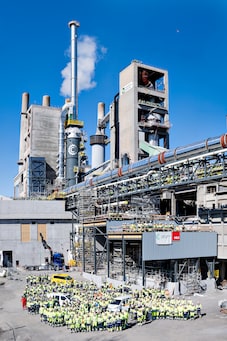
At the mouth of a fjord in Telemark County, south of Oslo, stands a thin steel chimney that could play a central role in the ecological transition of cement, one of the most difficult materials to decarbonise. The 100-metre-high chimney is brand new and serves to trap carbon dioxide emitted by the historic Brevik cement factory. The CO2 will then be compressed and transported by ship in a liquid state to an intermediate storage facility in Øygarden, north of Bergen, before being pumped via pipeline and stored permanently in a geological repository located 2,600 metres below the North Sea floor.
Feasibility study for Brescia
.The operational launch of the Longship CCS project - the first complete industrial chain for CO2 capture, transport and storage in Europe - was celebrated yesterday in Brevik, with all the key players involved, starting with Crown Prince Haakon of Norway, Norwegian Energy Minister Terje Aasland, and Dominik von Achten, CEO of Heidelberg Materials, owner of the Brevik cement plant, which thus becomes the first in the world to produce net zero cement. Thanks to the expertise acquired in Brevik, the German cement giant (which also controls Italcementi) has launched feasibility studies for CO2 capture and storage in a dozen other plants in Europe and North America, including the Rezzato-Mazzano (Brescia) cement plant, which could become the first Italian plant to produce net zero cement. 'We are in contact with the Italian government to realise this project, we know that there is an ongoing debate on CO2 capture, and we hope to replicate in Italy what we have already done in Norway,' van Achten confirmed.
Catch rate will rise to 95 per cent
.The brand launched by Heidelberg Materials is called evoZero and was developed right out of Brevik, where the specially developed technology will allow the capture of 400,000 tonnes of CO2 per year, or 50% of the plant's total emissions. In the next reconversions, the aim is to achieve even higher capture rates of around 95 per cent. In addition to Brevik, the Longship project includes the Hafslund Oslo Celsio waste-to-energy plant, which is set to become one of the first emission-free waste-to-energy plants, with 350,000 tonnes of CO2 captured per year, half of which is biogenic.
The complex scheme named after Viking ships is a central element in the Norwegian government's transition strategy, which has covered more than two-thirds of the costs: USD 1.9 billion out of a total of USD 2.82 billion. "Longship proves that it is possible to reduce emissions from the industry safely and effectively: we have built a complete value chain for CO₂ management that will have an impact beyond our borders," said Minister Terje Aasland at the opening. The ultimate goal of this major effort is the decarbonisation of oil & gas, which accounts for about a quarter of Norway's GDP and more than 50 per cent of exports. In fact, the oil sector is the main driver of the project, with Equinor, Shell and Total supplying the geological repository and building the pipeline to inject CO2 into it. The gas capture technology also came from Schlumberger, a leader in oil & gas services, through its subsidiary SLB Capturi, which specialises in carbon removal solutions.
The alliance of the three oil majors, called Northern Lights, aims to trigger the creation of a carbon capture market in Europe. In this first depot, the consortium will also transport and seal 800,000 tonnes of CO2 per year from the Yara ammonia and fertiliser plant in Sluiskil, the Netherlands, and 430,000 tonnes of biogenic CO2 per year from the two Ørsted power plants in Denmark. The consortium has just decided to expand its CO2 storage capacity from 1.5 to 5 million tonnes per year, with an investment of $715 million.

