
New A-levels set to begin: 527,000 students involved
Under the scheme chosen by Minister Valditara, examination boards have been reduced from seven to five members and the oral examination has been limited to four subjects
by Eugenio Bruno and Claudio Tucci
Key points
- The final vote
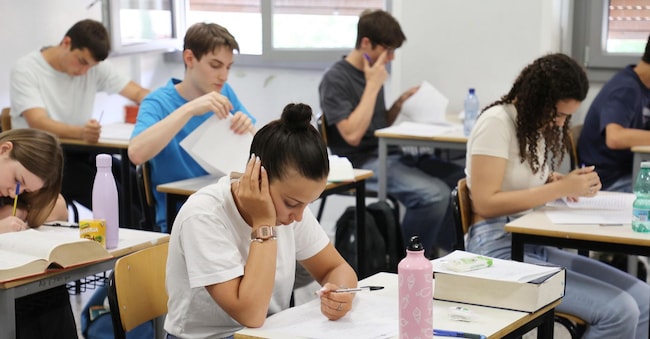
The countdown has begun for over 527,000 Italian sixth-form students, comprising both internal candidates (513,479) and external candidates (14,128), of whom 273,854 are at sixth-form colleges, 167,136 at technical colleges and 86,617 at vocational colleges. On Thursday 18 June, at 8.30 am, they will be called to their desks to sit the first paper, the Italian written exam, of the 2026 school-leaving exam, which has been revamped both in name (it will no longer be the ‘State’ but rather the ‘maturità’) and in its format. As demonstrated, on the one hand, by the oral exam limited to the four subjects identified by the Ministry of Education, together with the subjects of the second specialised paper scheduled for Friday 19th, again at 8.30 am. And, on the other hand, the reduction of the 13,989 examination boards to five members, comprising two internal and two external members, including the chair, rather than seven as previously.
The main changes
In reality, there are many more changes in store for them. The interview will be more structured; it will begin with a personal account and will only conclude once the four chosen subjects, the school-to-work pathway and civic education have been covered. It is forbidden to remain silent, as happened last year in a dozen or so cases that made the headlines: on the instructions of Minister Giuseppe Valditara, anyone who turns up and deliberately chooses to remain silent will fail, because the exam is only valid if the candidate completes all the tests.
Whilst the framework within which the oral examination must take place – and therefore the questions that the examiners may ask – remains the same, having once again been set out in the document dated 15 May published on the school’s online noticeboard and accessible to all, its structure has changed. It is no longer a single session before the examination board, divided into four stages, and it no longer begins with material chosen by the board. From this year, students begin with a brief reflection on their academic and personal journey that demonstrates their maturity. This is followed by questions and in-depth discussions on the four subjects. The interview then continues with a presentation of work-related learning experiences (the former ‘alternanza’ scheme, now known as PCTO) through a short report or a multimedia project, civic education skills, and a discussion of the written exams.
There are also changes on the horizon regarding assessment: for a grade of 6, the class council will set a critical essay on active and socially responsible citizenship to be discussed during the oral examination; a grade of 5 means the student is not permitted to sit the exam.
The academic merit points awarded during the final assessment remain unchanged. These are accrued over the second two-year period and the final year, up to a maximum of 40 points: 12 for the third year, 13 for the fourth and 15 for the fifth. The highest score can only be awarded if the conduct mark is nine out of ten or higher. The remaining 60 points come from the examinations, divided into 20 for each written paper and 20 for the oral. A new marking scheme is used to award marks for the oral examination, with the aim of standardising assessment practices across the country: the indicators have been reduced from five to four, each divided into five performance levels, with a score ranging from 0.5 to 5 points for a total maximum of 20. Throughout the interview, the board keeps an eye on the student’s curriculum vitae, which is no longer merely an attachment to the diploma.


Brand connect


Newsletter Scuola+
La newsletter premium dedicata al mondo della scuola con approfondimenti normativi, analisi e guide operative
Abbonati