
From Iberia the new aircraft that will revolutionise long-haul air transport
CEO Marco Sansavini: 'Now we will change our network'. The company has ordered eight aircraft, another six Air Lingus
by Mara Monti (Madrid)
3' min read
Key points
3' min read
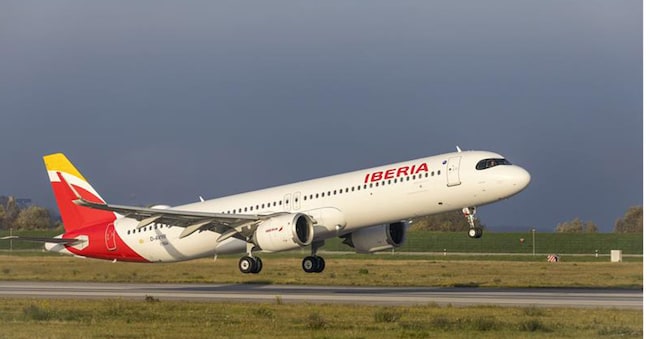
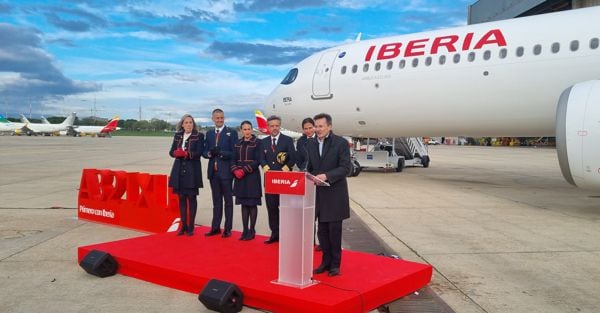
The most revolutionary aircraft of recent times, the Airbus A321XLR will make its first long-distance flight tomorrow in the livery of Iberia, leaving Madrid at 12:35 p.m. and arriving in Boston, Massachusetts at 3:20 p.m. local time. The Spanish company is the launching carrier of this aircraft that on paper is destined to bring a breath of fresh air to the air transport sector. The first of eight aircraft ordered, the next will arrive in early 2025 and will be destined to cover the route from Madrid to Washinghton DC. "With this aircraft we will be able to operate this route all year round and not only in the summer as is the case now with the A330," said Iberia CEO Marco Sansavini at the press presentation of the aircraft at the La Muñoza hangar in Madrid.
First flight to Boston then Washington DC
The aircraft was delivered on 30 October by Airbus to the Spanish carrier and has since made a few flights in Europe, from Madrid to Paris and to Stockholm as regulations require before starting long-haul flights. "We are very proud to be the first airline in the world to start flying the A321XLR (Extra Long Range). This is a milestone in aviation and allows us to strengthen our network and fly to new destinations efficiently and comfortably for all our customers," added Sansavini. In addition to Iberia, Air Lingus, the group's Irish airline, will also have six aircraft in its fleet, bringing the total to 14 XLRs in the IAG group. "We are fine-tuning our group strategy to 2023 to include the new aircraft in our network and beyond Boston and Washington we will add new routes to the Americas," he specified.
Certification arrived a year late
.It had been since the pandemic crisis that a new aircraft model had been released and the companies had been waiting for it, queuing up among the more than 500 orders collected so far from 25 carriers around the world, as Cristina Aguilar, Head of Office Customer Service Worldwide of Airbus, recalled: the Airbus A321XLR is a single-aisle aircraft, an extension of the Airbus A321neo family, but - and this is the novelty - adaptable to long distances up to 4,700 nautical miles (about 8,700 kilometres) the longest in its category. Actually, the ArbusXLR has the same fuselage as the A321 with a configuration between 180 and 240 passengers. The difference lies in the fuel tank in the hold to have more fuel available for longer flights, a peculiarity that created problems at the time of certification, delaying the green light for the aircraft from Easa, the European flight safety authority, by a year.
Features and comfort of the new aircraft
In the case of Iberia, the maximum extension is 4,000 nautical miles (7,500 klometres) for the 182-seat configuration type (14 business and 168 economy): the company assures that comfort is comparable to the A350 and A330 widebody, providing in-flight meals, full flat seats in business class, positioned in a fishbone shape to guarantee privacy and freedom of movement, 30-inch seat pitch in economy, reclining seats, in-flight entertainment, Wi-Fi.
An optimal solution since Iberia will be able to expand routes without having the costs of a widebody, with 30% less fuel consumption and with fewer personnel on board, two pilots and four cabin crew, the same as the entire Airbus 321 family. A dream for the carriers that after Covid certified the end of the season for mega carriers such as the Boeing 747 and Airbus 380. Even Boeing had found the answer to the A321 XLR by identifying it in the Boeing 737 Max-10, at the moment still undergoing certification by the FAA. In reality, Airbus' newborn aircraft fills a market segment vacated by Boeing's own twin-engine 757, which ended production in 2004, until then the largest single-aisle passenger aircraft ever built.


