
New nostalgia cinema (of eras never lived)
Lynch's films are returning to the theatres, but also old glories that have become legends like 'Scarface' or 'Amadeus'. Many viewers are boys. Why?

5' min read
Key points
- The importance of the body in front of the big screen
- The return of 'Scarface'
- The return of David Lynch's films
5' min read
Understanding why a handful of boys with mullets and ears full of balls and metal hoops swallow themselves up in the darkness of a movie theatre to see a film made several decades earlier is an exercise in conjecture or blunt philosophy perhaps, but a necessary one. What is it about those guys in their baggy ottoman trousers or jeans up to the apex that they share with couples or single agée of the so-called reflective middle class in front of the screen of Scarface forty years after its release? Nostalgia. For the former, it is prickly longing for eras they have not lived through, but consider mythical and formative for the ideals that forged them. They love record players and cassette players, vinyl records, the songs of De André and the Beatles. They approach an era when the cult of the new and productivity at any cost was only puberty and perhaps a game, not a pillory. For the latter, it is a longing to return to what no longer exists, a time when the cinema was a regular weekend fixture or a den in which to throw oneself into agnostic moments. A bittersweet feeling of reminiscence and security.
The importance of the body in front of the big screen
It is naturally the youngsters who are most interesting in this desire to approach the big screen to discover past titles, which are re-released in cinemas on an almost weekly basis. Not that this is a new phenomenon, but the enjoyment, often unrelated to recurrences, has new nuances. Cinema, as an art little more than a hundred years old, has always been a terrain of discovery. As it grows older, for younger people it becomes a historical source, a source of knowledge of films with different content from those of today, more devoted to aesthetics, spectacularization and entertainment. Definitely an anchor in a world that is changing fast, especially in work, and a place of aggregation. The big screen for cults becomes a form of resistance to the imperium of platforms, whose usability on small or very small devices has become a boomerang. The offline clubs have sprung up in Amsterdam, Berlin, London, Paris, Milan and Barcelona, spaces dedicated to socialising without screens, where mobile phones are banned and conviviality is made up of board games and books to read in the comfort of others' presence. Bookclubs are also spreading, where at dinnertime we talk about a title that the circle of friends has 'imposed' as the reading of the month. If TV series were projected on the big screen, young people would go and see them there, as a useful event also to separate reality from fiction through collectivity, because the problem of some young people today is that they sometimes get confused, they don't really know if an experience they have really lived or they have seen it in a series on the small screen. The pre-televisual golden age of cinema will no longer return, but there will be a niche 'market', strong and aware, experienced differently by two segments of the audience: digital natives and non-digital natives.
The return of 'Scarface'
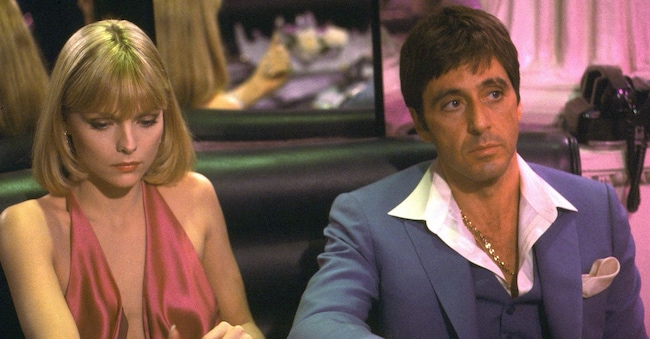
.Something new was felt in April last year, when Scarface returned to theatres after 40 years. With a screenplay by Oliver Stone and Al Pacino as the thug Tony Montana, it went from flop to cult. The writer went to put his nose in the theatre: many of the boys commented in surprise that Montana was already wearing the cut on his eyebrow at the time, which mimics an urban fight scar and is so fashionable now. The buzz cut, the hair shaved to the millimetre, which is very popular among boys, was seen on all the protagonists of Full Metal Jacket, in cinemas last October. Those who lived through the days of compulsory naja remember it, but for young people the army only evokes war scenarios. It has to be said that the way one dresses or wears one's hair no longer has any political significance. The big brands have chewed up, reworking them according to the chrisms of luxury, what had been signs of protest against society: the punk studs and studs, the amphibian boots and big miner's shoes of the social centre-goers, the camouflage of those who used to be on the right. The same goes for tattoos, once a symbol of belonging to a certain marginal or underground milieu, now pure fashion and probably the only lasting thing young people can afford (not the house, not the car, so much so that they don't get a driving licence).Nothing is really invented, the cinema teaches us, not even mobile phone alienation: Charlie Chaplin had already warned us in Modern Times or Metropolis by Fritz Lang. The neurosis that runs through people today was already present in all of Cassavetes' films in the 1960s. Cinematic feminism did not start with Céline Sciamma, it was already radical in the days of Agnès Varda and Chantal Akerman. It was curious to see how many young people were there for the homage that the Milan Film Library dedicated to the Franco-Belgian director. Similar was the youth audience for The Shining, true bread for the digital natives: more distant from the body than us, but no less sensitive, they enjoy horror with a laugh.
The return of David Lynch's films
.In the last few weeks, David Lynch's masterpieces can be found in cinemas again. From 16 June, Elephant man from 1980, one of the most pitiful films towards the last without appeal, returns. Along with it, there will also be A Clockwork Orange, or extreme youth violence in 1971, now that we are constantly shouting at the monster-boy, why don't we remember Maso, Erika and Omar or the murder of 16-year-old Giacomo Valent by two peers in 1985 because 'he was a dirty nigger'. The homage to Lynch is surely almost 'obligatory' after his recent death, since TV, overrun by talk and reality shows, hardly fulfils the memorial function any more. But what are we to make of the fact that three of Lars von Trier's musts: Dogville, Dancer in the Dark and The Waves of Destiny will be in theatres in June in 4K editions?
The cold of winter gave us back Akira Kurosawa (Stray Dog, The Seven Samurai, Sanjuro and Living), Leone's much-loved Once Upon a Time in America and Coppola's The Godfather. Then we jumped from Interstellar to Pulp Fiction, to In the mood for love and Milos Forman's crazy Amadeus. Kids reclaiming pre-digital humanity is like Belgrade students walking to Brussels to demonstrate against authoritarianism.


