The human factor

The new generation and the career prospects of craft work

A high value-added job, highly sought after in the luxury sector: by 2028 the market will need 75,000 figures. But the supply today does not reach 50 per cent.

by Silvia Paoli

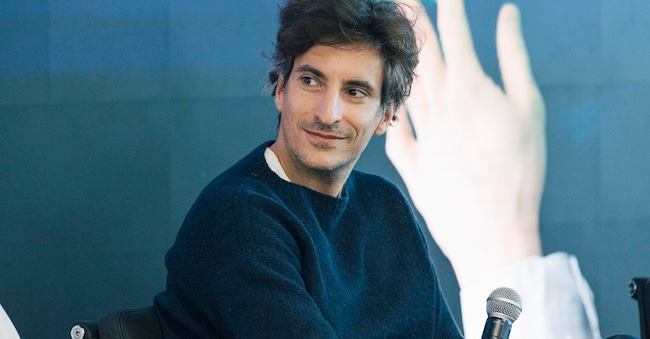
Lorenzo Bertelli, chief marketing officer & head of corporate social responsibility Prada Group. (COURTESY PRADA GROUP)

6' min read

Translated by AI
Versione italiana

6' min read

Translated by AI
Versione italiana

Scandicci, Prada factory in Via Pisana. Interior day. 'You mustn't be in a hurry in luxury, if not you do other things, taps...'. Andrea Guerra is seated on the illuminated stage, behind him an image of working hands, real, pixelated orange-on-blue hands, and the reason for the meeting: 25 years of the Prada Group Academy, the Trade School that trains the younger generations in manufacturing in the leather goods, clothing and footwear sectors. Seventy per cent of the students who complete it successfully are hired by the company.

We talk about the weather, not the weather. The ability to transport the past into the present, and at the same time plan for the future, revolves around a crucial issue: companies, all of them, are struggling in the turnover of people working in manufacturing, because manual jobs have been abandoned to follow immaterial ones. This is a flight of hands, as well as brains, of hands that need to find their satisfaction in fulfilling and inspirational work.

Loading...

For there to be a desire to learn a trade, a slow trade, it must be made clear to everyone that it is not a mere assembly of parts, but an attractive path to growth, in an environment that cares about its craftsmen.

Andrea Guerra, amministratore delegato e amministratore esecutivo Prada Group.

The concept of the Prada Group CEO and executive director Andrea Guerra can be summed up in a syllogism: if training is the keystone of industrial craftsmanship, then industrial craftsmanship is the keystone of Made In Italy. Ergo: training is the keystone of made in Italy. "By 2028, more than 270,000 specialised figures will be needed in manufacturing, 75,000 of which in luxury alone, and it is estimated that today there is only 50% supply compared to demand. How do we bridge this gap? I see in young people a desire for a different life, for a better lifestyle, with less alienation. It is up to us to create the conditions for this, to make them understand that manual work is not just assembly, but teamwork, in which different aptitudes are tried out, in which ingenuity, what is human in doing a job, is valued. It is up to us to give content to our work'.

I giovani dell’Academy al lavoro nello stabilimento di Prada a Scandicci.

The view of Lorenzo Bertelli, chief marketing officer & head of corporate social responsibility Prada Group, is lateral and starts from personal experience. "When I chose the faculty to enrol in, my peers, from the most to the least, all wanted to do Bocconi" - for the record, he did Philosophy, and his favourite philosophers are Plato, Kant, Nietzsche. "Many ended up doing a completely different job from what they imagined. The myth was The Wolf of Wall Street. But today we are in a world where technology is replacing processes, which are easier to automate. In contrast, craftsmanship cannot be replaced. Technical and specialised trades are high value-added trades and will not disappear; on the contrary, they will be sought after and remunerated. Already last year in the US, the average wage of a blue collar worker was higher than that of a white collar worker. In ten and twenty years the paradigm will be reversed, manual labour will be more sought after and paid than white-collar work. That is why we are implementing an internal marketing path with human resources'. The people strategy is to put people at the centre, to work on their emotions, to involve them ('If they get excited about what they do, people will stay in the company,' says Rosa Santamaria Maurizio, who in the Prada Group deals precisely with people. And then internal talent must be cultivated and enhanced. A project desired by Lorenzo Bertelli is called Be Drivers of Change: it is a kind of competition inviting employees to propose ideas for solving practical or technological problems, or for improving working conditions. With unexpected positive results: Manuel, who attended the Academy in 2018, proposed 7 innovative ideas in 2025, placing second with a stunt that solved a security problem (top secret, of course).

But are the new generations really ready to embrace this slow, ancient, too-human career? In Italia, there are 1.4 million inactive young people between the ages of 25 and 34 - 23.4 per cent of the population compared to the European average of 13.9 per cent - and more than one in four has a university degree. We talk about this with Francesca, who is 27 years old and works in the Prada Scandicci factory, having trained at the Academy. "I am the first in my family to do this job, no, the first one to do it was my younger brother. I attended DAMS, I graduated, but then I decided to change completely, to give a little more attention to what I like to do. I had to train myself and coming here was the best choice. Before, I had a general idea of what craftsmanship meant. Many kids my age don't know about it, they are afraid of having to do the same thing all their lives, I myself didn't realise the variety of activities one can try and the potential of this path. This is a profession where you learn something new every day. 'Stealing with your eyes is fundamental,' they used to tell us at the Academy. And if you learn, you can grow'. The slowness, the scare of being out of sync with today's rhythms, does not touch her: 'It is necessary, before arriving at the finished product, before being autonomous, before finding your favourite task: I discovered the sewing machine, for example. It inspired me, I tried it out and I was confirmed. I was a bit scared, but every day with the guidance of the masters and without hurry, you learn'. I wonder if he realises that he is a fundamental part of the longevity of Made in Italy. 'I feel the responsibility. But also the pride of making a small personal contribution'.

Leonardo, 27, also trained at the Academy and has been working for four years as a craftsman in the Scandicci factory. 'I discovered it online, I wanted to change company, to enter the world of luxury, I signed up for the test day, the Assessment, and I was selected'. After finishing the training, he went into production. 'Every step is interesting, every gesture requires the utmost precision'. If he thinks about where he will be in 20 years' time, he hopes he will be 'still here: it wouldn't be bad, maybe seeing all the departments, until you reach that role that allows you to start from scratch, from a piece of leather, and arrive at the finished product, that very bag, without needing the intervention of others. But even now in the evening when I get out of work, I feel satisfied'.

CEO Andrea Guerra's idea is that young people, in order to be successful in the working world, must be humble and uncomfortable. Leonardo, who was 23 when he was chosen, smiles: 'Humble you have to be if you want to learn and grow your skills. Uncomfortable, perhaps, is how you do it. Uncomfortable are the questions you ask, when you have to understand not only what to do, but how to do it. When you want to remove all doubts, all uncertainties. After all, that's the only way you can make yourself autonomous'.

Masters of Made in Italy

The Prada Group Academy, the group's School of Trades conceived in the early 2000s, is a strategic pillar of the company's training, with learning paths in the leather goods, clothing and footwear sectors. The heart of the Leather Goods School is the plant in Scandicci, Florence, one of the group's main production poles, where products for the Prada and Miu Miu brands are made. The pole employs a total of 405 people spread between the sites in Via Pisana and Via delle Fonti, with 67 per cent of the workforce under the age of 35. The Academy's strength lies in the right mix of theory and experience: the study of raw materials, production and business processes is fundamental for subsequent practical training in the field, under the guidance of technical experts. In 2026, the Academy will start ten courses involving all three categories: leather goods, footwear and clothing. The first course is scheduled at the end of February in Tuscany and will focus on footwear. In the Store Academy for sales personnel, on the other hand, the aim is to convey in-depth knowledge of the collections and products of each brand, so that they can offer customers a unique shopping experience. The programmes dedicated to technical product information are complemented by a broader narrative explaining the company's choices and philosophy. The training also deals with communication and the use of digital technologies that give retail staff immediate access to a wide range of information and content useful for effective customer dialogue.

Copyright reserved ©
Loading...
Loading...

Newsletter

Notizie e approfondimenti sugli avvenimenti politici, economici e finanziari.

Iscriviti