
New materials and artificial intelligence to remain a leader
The industry responds to regulatory and geopolitical challenges with multidisciplinary creativity resulting in novel finishes and digitisation

4' min read
4' min read
Inventing materials that shift the boundaries of traditional ceramic surfaces. Experimenting with new textures, decorations and performance, integrating artificial intelligence at the design and production level, also from a supply chain perspective, to increase the resilience of the entire sector. The new edition of Cersaie, from 22 to 26 September, is a manifesto of Italian inventiveness, in a context that requires continuous innovation to confirm the supremacy of Made in Italy over the top of the range year after year. This in a complex season, amidst energy costs, more stringent environmental regulations and competition from non-EU giants, India in the lead.
Precisely because the industry faces global challenges - ranging from raw material shortages and regulatory pressures to market volatility and geopolitical risks - it is essential to work from a multidisciplinary perspective. This is the aim of Volt (Viability for circuLar manufacturing), the industrial research and experimental development project promoted by the Gresmalt Group as lead company, Sacmi and Zschimmer & Schwarz Ceramco, in collaboration with the University of Pavia and the University of Brescia and co-financed by the Ministry of Enterprise and Made in Italy, which will end in December 2026. "The focus is not so much a process innovation, but a strategy innovation," says Alessandra Salvarani, Chief Esg officer and Vice President of Gresmalt. "The first objective is to ensure business continuity at a time of great geopolitical uncertainty, and the tool we are validating in the company is a digital twin, a simulation model that is usually applied on machinery or a production line, and that quisi extends to the entire supply chain, integrating data on the environment, society, economy and technology, to implement predictive functions". At the basis is a geo-referenced database containing 881 raw material extraction sites in Europe - more than half of which are in Italy, and the development of tools to track the carbon footprint along the entire supply chain, even for chemical additives. On the future, Salvarani anticipates a development towards cognitive manufacturing: 'The qualitative leap of AI will not be in predicting, but in generating: today we transform data into information and knowledge, tomorrow the factory will think and act, thanks to an intelligence that is no longer punctual, but distributed, creating the future in the present'.
Artificial intelligence is therefore one of the tools to keep us firmly on the podium of innovation and quality. "In January we introduced Ia both at process and product level," explains Francesco Maturo, CEO of Italgraniti Group. "It is a software developed specifically for us, which helps technicians to match graphic design and structure, obtaining very realistic products because it is able to process, analyse and suggest where best to deposit the colour on the sheet of material. Finally, the optical choice exploits a new type of vision that, thanks to Ia, signals anomalies below the millimetre, self-learning from errors and correcting them. In addition to greater precision, we are already seeing an increase in process speed. At Cersaie Italgraniti will be bringing "large slabs for kitchens and furnishings with RealUp technology, which enhances the realism and sense of authenticity of the ceramic surface, expressing a materiality and aesthetics never before seen on these formats," adds Maturo, also the result of the 100 million euro investment in the production asset over the last five years, which has upgraded the historical factory and built one dedicated to large slabs up to the maximum size of 160x320 cm. "This is a segment that attracts great interest, both from designers and the traditional distribution circuit," Maturo notes. The group has always had a strong propensity to export: we are growing especially in Europe, a historically strategic market, but also in the Italian market, which today absorbs 25% of turnover'.
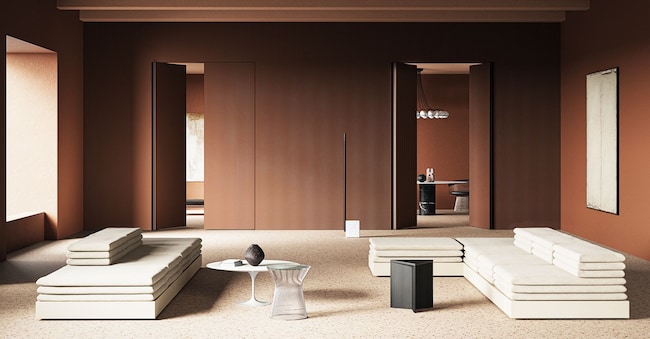
Innovation translates into a new product vision, which shuffles the cards starting with the raw material. "We wanted to rewrite the language of the door, proposing solutions that combine function and architectural vision and introducing a new material," says Fabrizio Campanella, CEO of Scrigno Group. Cimento, featured in particular on the new Mappa Mundi collection designed by Elisa Ossino, is a patented material produced in Italy, composed of 90% recycled mineral aggregates, made with processes powered by up to 100% photovoltaic energy, with complete offsetting of residual emissions. A material that complements - without replacing - wood and expands its potential, integrating with water-based lacquering and precision machining and applicable on all types of opening - casement, sliding, flush with wall and with jambs. "In the future, we also plan to apply it to armoured staircases," Campanella adds. Cimento resists moisture, requires no protective treatment and offers high durability, making it perfect for the contract sector as well, but "sensory comfort is perhaps the central element: it is a material designed to be experienced, touched, integrated into the living experience," Campanella concludes.
Also on the front of aesthetics applied to innovation, "today more than ever, success is measured by the ability to transform Made in Italy into a manifesto of beauty and technological innovation," explains Riccardo Monti, CEO of Energieker. The brand is bringing to Cersaie the evolution of HiSense technology, "which is based on the targeted application of microparticles in the concave areas of the surface," adds Monti. "An approach that makes it possible to achieve the R10 non-slip target, while maintaining a surface with a velvety softness to the touch. But we are opening up new frontiers, with tiles with backlit and glitter effect graphics, which transform surfaces into functional works of art". The company brings to Cersaie 3D surfaces and structured decors that integrate stone effect graphics and relief textures, which create material depth and interesting plays of light, but above all "a complete design ecosystem, where architects and designers find all the tiles to bring their creative visions to life," Monti concludes.

