
New orders for Palermo as Fincantieri’s revival continues

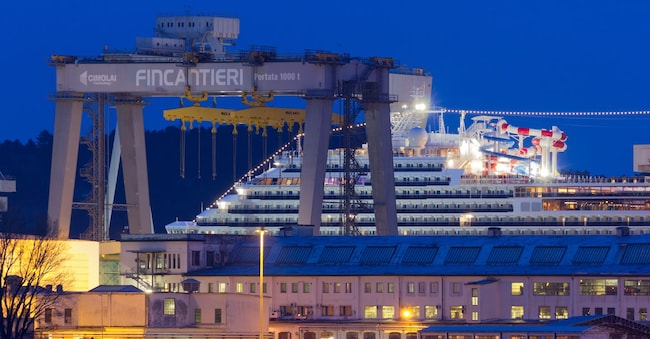
The latest news came a few days ago and, if confirmed, will extend the production horizon of the Palermo shipyard into the next decade. From 2032, two new expedition ships could be built at Fincantieri’s Sicilian yard for Silversea, a company belonging to the Royal Caribbean Group. This was reported by Shipping Italy, which states that a Memorandum of Agreement has been signed for two vessels of around 30,000 tonnes, with options for further builds. The agreement is expected to be formalised into a contract by the end of the year. Fincantieri neither confirms nor denies the rumour and remains tight-lipped regarding any ongoing commercial negotiations.
The potential order, however, does not come out of the blue. Silversea is already a client of the Palermo-based shipyard, where over the years lengthening programmes have been carried out and, more recently, modernisation work on the Silver Muse and Silver Spirit. A potential order for new expedition vessels would therefore mark a further step: from conversions to the construction of new vessels for an existing client. Meanwhile, in March, Fincantieri awarded the contract to Palermo for the construction and delivery of two expedition vessels ordered by Viking, scheduled for 2030 and 2031: 189 cabins, 378 passengers and Polar Class 6 certification. For Chief Executive Pierroberto Folgiero, the decision reinforces Palermo’s role as a ‘fully integrated production hub’ within the Italian industrial system and confirms a path of ‘structural growth’. More recently, speaking in Palermo itself, Folgiero described the shipyard as “an integral part of the Fincantieri Group’s development programmes”.
These statements are reflected in the 2026–2030 Business Plan. In the ‘Capacity Boost’ programme, Palermo features alongside Ancona and the Romanian shipyard in Brăila among the sites selected for investment to increase production capacity. The plan provides for a total of 1.9 billion in industrial investment up to 2030 and aims, in the cruise sector, for a 10 per cent increase in overall capacity, though it does not specify what proportion will be allocated to the Sicilian facility.
This change of pace is already evident in the orders received. The Costanza I di Sicilia, built entirely in Palermo, entered service on 6 August on the Porto Empedocle–Linosa–Lampedusa route. The tender had a starting price of nearly 120 million and included an option for a second vessel, for which the Region is still seeking funding. In May, the bow section of the Explora V – the fifth vessel in MSC’s luxury fleet – was also launched in Palermo, before being sent to Sestri Ponente for completion. In April, the shipyard delivered the Tritone to the Italian Navy: an Offshore Support Vessel converted for underwater operations. Since 1984, the year it became part of Fincantieri, the shipyard has completed 46 newbuilds – including ship sections – which have been launched and delivered, as well as 73 conversion projects. The real leap forward lies in the ability to return on a continuous basis to the construction and delivery of complete ships, alongside repairs, conversions and the prefabrication of large sections. The employment figures also reflect the scale of the site: 525 direct employees and around 2,500 people across the local supply chain and external suppliers. A supply chain of over three thousand workers makes the shipyard one of the main manufacturing operations still operating in the urban area of Palermo.
Part of this reorganisation is the decision, taken on 29 July, to merge with Bacini di Palermo Spa, a wholly-owned subsidiary that manages the dry docks used for shipbuilding, repair and conversion. Fincantieri cites the simplification of the structure and greater integration of operational activities as the reasons for the merger. Formally, it is a corporate rationalisation, but it comes at a time when Palermo is entering its asset enhancement programme and preparing for a new cycle of shipbuilding.

