
New Renault Austral, here's what it looks like, how it goes and how much it costs
Updated inside and out, enriched with new technologies and made more comfortable, the SUV also comes with a remodelled range of equipment and powertrains, only hybrids
5' min read
5' min read
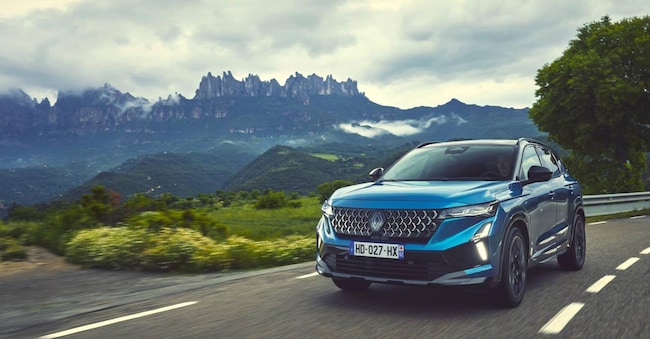
Renault continues to expand and update its densely packed range of suvs by revamping the Austral. The model ranks among the mid-size suvs with a range consisting only of hybrid versions. The new series is aesthetically aligned with the latest Renault models, adopts solutions that improve comfort and driveability and also debuts technologies that will arrive on other cars of the brand. In addition, it comes with a remodelled range, as it now consists of three trims, the Evoltion and Techno as well as the Esprit Alpine, reconfirming two of the three powertrains offered in the past. Namely, the mild hybrid with 160 horsepower and the full hybrid with 200 horsepower. Sales will begin in early June with a price list that is assumed to start at just over EUR 36,000.
Renault Austral, stylistically aligned with the Espace and Rafale
.Still based on the third-generation Cmf-Cd architecture of the other mid-size and large Renault models, the 2025 edition of the Austral retains practically the same dimensions as its predecessor. In fact, only the length is increased by a few centimetres to 4.53 metres, while the width of 1.83 metres and height of 1.62 metres remain unchanged, as does the wheelbase of 2.67 metres. The restyling integrates into the bodywork styling cues that debuted first with the Rafale suv-coupe and then with the sixth generation Espace, the one with which it entered the suv world. The Austral approaches these models by sporting the same expression thanks to a completely remodelled front end, which combines a flatter design with a larger grille made up of many small lozenges inspired by the Renault logo and a new slim adaptive LED headlamp, and a newly shaped bumper shield in which the daytime running lights are inserted to complete the brand's current lighting signature. The aesthetic revision continues with finishes in the lower part of the bodywork in a contrasting colour that do not distort the design of the sides too much, arriving at the rear, where the tailgate stands out, reshaped in its central and upper parts, together with light clusters that are less large and more rounded than their predecessors. The appearance of the Austral, of course, is affected by the customisations that also appear in the passenger compartment linked to the three trim levels.
Renault Austral, inside offers more comfort and recognises the driver
.The interior of the new Austral still offers modularity due to the rear upholstery that can slide 16 centimetres longitudinally and an amount of space that satisfies even those sitting in the back. The width of the passenger area does not affect the luggage capacity which, with the rear sofa all the way forward, ranges from 557 to 1,761 litres when the mild hybrid engine is inside the bonnet and from 527 to 1,736 litres when the full-hybrid system is fitted. The interior design is unchanged, so it is based on a pleasing presentation that is also supported by careful finishing and the use of quality materials that are recycled in a higher percentage than in the past, as well as very complete equipment, especially in the case of the top of the range trim. The interior design follows in the vein now dear to Renault and, therefore, is characterised by the wide console between the front seats surmounted by the sliding 'handle' armrest that covers one of the many storage compartments dotted around the room and the linear dashboard, which supports the configurable 12" instrument display (a 9.3" head-up display is also available as an option) that combines with the 9" or 12.3" vertical central display, depending on the version of the OpenR Link infotainment system with a renewed graphic interface, now based on Android 12, which integrates Google services and offers dozens of apps.
The redesign of the interior also involves the gear lever to the right of the steering wheel to limit, admittedly with little success, confusion with the windscreen wiper lever, the paddle and satellite with hi-fi controls crowding that area. It has also brought on board more comfortable front seats, a camera on the front left pillar of the headlining that identifies the driver, five profiles can be set, storing his preferences (from the electrically adjustable seat and rear-view mirrors to climate control and navigation) and proposing them when he recognises who gets behind the wheel. The system will also be introduced on other Renaults. Finally, to improve acoustic comfort in the cabin, new door seals, laminated glass and redesigned mirror bases have been used to reduce aerodynamic noise.
Renault Austral now offers two powertrains along with gearbox and trim upgrades
.The revision of the Austral is completed by the discontinuation of the 1.2-litre 130 bhp three-cylinder turbocharged engine with 48 V technology and the reconfirmation of the 1.3-litre 160 bhp four-cylinder mild hybrid engine with continuously variable gearbox with seven preset gears for the Mild Hybrid 160 version and the 200 bhp full hybrid powertrain for the E-Tech 200, which is essentially a tri-engine. In fact, the self-charging system is composed of a 1.2-litre three-cylinder engine with 130 horsepower, an electric unit with 70 horsepower for traction and another electric unit with 25 horsepower that acts as starter, generator and synchroniser for the electro-actuated gearbox, which dedicates four gears to the petrol engine and two to the more powerful electric one. Its operation has been optimised to offer smoother and more responsive running and is orchestrated not only by the four car configurations, but also by numerous strategies defined by the electronics that tend to favour driving under the impetus of the electricity stored in a 2 kWh battery. The Austral can always be equipped with four-wheel steer to increase dynamism and Extended Grip to optimise traction on low-grip surfaces, while the entire range adopts new hydraulic progressive damping dampers and larger tyres as standard and a suite of Adas with 32 systems for advanced level 2 semi-assisted driving.

