
New sea transport alarm, container freight costs tripled
Transits in Suez halved: 700 ships to the Cape of Good Hope in July. Zanetti: 'Unthinkable that the costs of the green transition should only be borne by the private sector'
3' min read
3' min read
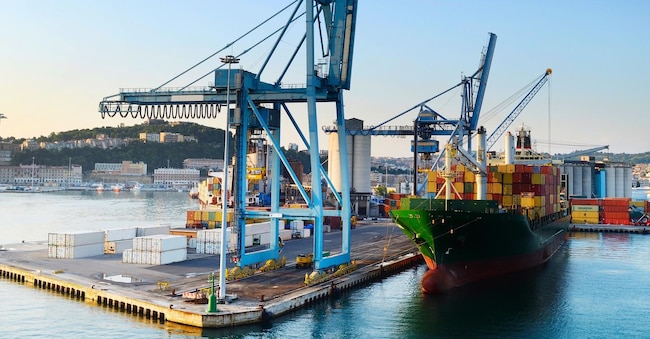
While traffic through the Suez Canal continues to decline to the point where transits are practically halved, container freight rates are growing exponentially again, reaching peaks of +306% (on the Shanghai-Genoa route) compared to last year.
Moreover, global seaborne trade increased by 2.2% in 2023 to 12.3 billion tonnes and will grow by 2.4% in 2024 and 2.6% in 2025. The situation in the Red Sea, therefore, does not interrupt the flow of maritime transport.
This is recorded in the Report 2024 Talian maritime economy, prepared by Srm (the research centre reporting to Intesa Sanpaolo), which also highlights how for the Mediterranean, despite the ongoing conflicts, an average annual growth rate of just over 3% is expected between now and 2028, compared to a world average of 2.5%. Also in the Mare nostrum, short sea shipping traffic recorded its strongest ever, at European level, with almost 600 million tonnes handled. As for the green transition, the use of alternative fuels continued to progress, with 6.5% of the seagoing fleet able to use new, less polluting propellants. This percentage will reach 25% by 2030. As of July 2024, 50.3% of all ship orders are for vessels using alternative fuels (in 2017 this share was only 10.7%).
"The data presented by Srm," said Mario Zanetti, the Confindustria president's delegate for the Maritime Economy and leader of Confitarma, "clearly highlight the importance of both maritime transport and global maritime trade, which is confirmed as the backbone of international trade. It also emerges that maritime transport is the most efficient mode in terms of carbon emissions. Indeed, the sector is implementing the green transition targets, but to reach the net zero target by 2050, zero-emission fuels are not currently available in the quantities needed, and the costs of the transition are enormous. Suffice it to say that to halve current emissions, the shipping industry would have to invest USD 1.4 trillion. It is unthinkable that this could all be borne by companies alone: private investment, which is still there, needs to be matched by public support'.
Zanetti then added that, "at a crucial time like this, it is necessary to implement the priorities outlined in the Plan for the Sea, the Government's strategic document, defining together the actions to be undertaken, in a collaborative and development logic for our country. For this reason, Confindustria, in order to relaunch the competitiveness of the Maritime Economy sector, has adopted a new industrial policy approach built on three strategic drivers: ports, carriers and fleets, and people and their skills".


