
Nicola Pietrangeli: talent, worldliness and that unforgettable Davis
A legend in the era when tennis was more about flair than power. The Salad Bowl won as captain in the trip to Chile opposed by politics and civil society

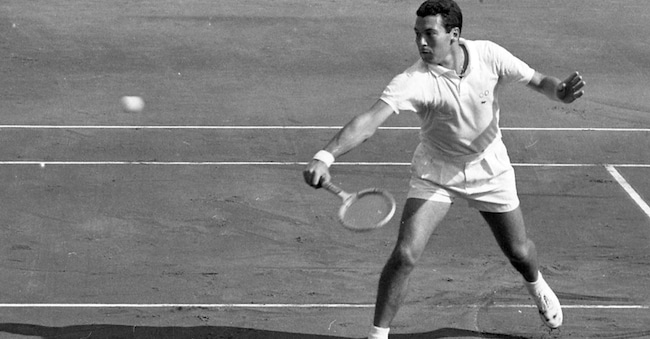
He held out to the last against illness, old age, even against the death of his son Giorgio, the last great sorrow. Then, just a few days after the victory of the Azzurri in the Davis Cup in Bologna, he was gone: Nicola Pietrangeli - the legend, the teacher, the talent, the captain of that team that for the first time gave Italy the Salad Bowl - died at the age of 92.
A life that resembles a novel, from his birth in Tunis to his arrival in Italy, from his victories on the most prestigious pitches to his worldliness (he can't count the parties and evenings with friends from the world of show business), from his ability to unite his boys to that of fuelling the controversy in the crucial '76 season, up to his constant presence in the stands to applaud the new generations (always wearing black glasses to protect his eyes). He has now joined the other protagonist of an unrepeatable era, and his great friend: Lea Pericoli, who passed away last year.
Pietrangeli won in the era of champions such as Rod Laver, when tennis was more about flair than power, and for years he was the only one to have given us two clay court titles at Roland Garros (1959 and 1960) and two at the Internazionali d'Italia (a court in Rome bears his name), until a certain Adriano Panatta, the son of his club's caretaker, came along and stole the sceptre from him and challenged him. As talented and handsome as Nicola. Who for long years, those when there was no computerised ranking, dominated Italian tennis and not only. He also proved prodigious in doubles, with his lightning-fast backhand. Paired with Orlando Sirola he won Roland Garros and reached the final at Wimbledon (they lost to Lew Hoad and Ken Rosewall). On grass in singles he reached the semi-finals, for a long time the best Italian result: Panatta never went beyond the quarters, Berrettini only made it to the last act in 2021.
The masterpiece was Davis, never brought home as a player (two finals lost to Australia) but grabbed as captain in '76: the Panatta-Bertolucci-Barazzutti-Zugarelli dream team gives him the credit for having first played it, in Pinochet's Chile. It was Pietrangeli who fought for that trip, which was opposed by politics and civil society, as well recounted in Domenico Procacci's series Una squadra. The second phase of his life was that of honours, of memory, of tributes for what he represented. Also of the melancholy of someone who knows he was a champion and lives in the memory of extraordinary years. You will be in all our hearts, Nicola.


