
Niger: Shooting at the airport leaves 11 soldiers and two civilians dead. Al-Qaeda claims responsibility
Niamey airport has come under attack again following January’s Islamist offensive, highlighting the vulnerability of the Sahelian juntas
from our correspondent Alberto Magnani
 Aggiungi Il Sole 24 Ore
ai preferiti su Google
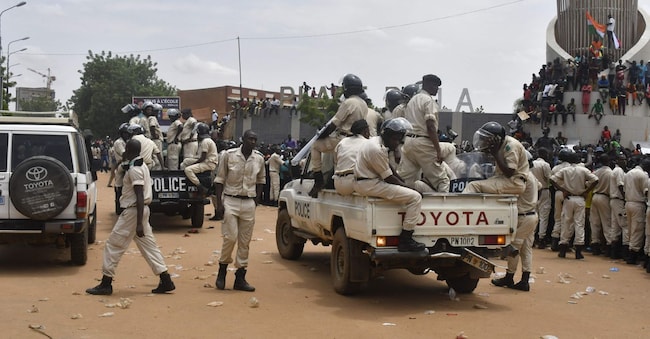
NAIROBI – Niamey airport has come under attack again, just a few months after the raid launched in January by Islamic State militants and repelled by Nigerien security forces. Witnesses quoted by the Associated Press report gunfire and explosions in the early hours of the morning, whilst the authorities in Niamey have confirmed several casualties on both sides of the attack. The death toll is reported to include 11 soldiers, two civilians and 22 attackers killed, but this figure may rise as the day progresses. Later that evening, the al-Qaeda-linked group Jama’at Nusrat al-Islam wal-Muslimin (JNIM) claimed responsibility for the attack, an incident that has heightened the terrorist threat and highlighted the precarious nature of the counter-offensive being waged by the authorities in Niamey and their Russian allies from the former private military company Wagner.
Niger is governed by a military junta led by General Abdourahamane Tchiani, who came to power in 2023 following the coups that had already taken place in Mali (2020, 2021) and Burkina Faso (both in 2022). The military governments overthrew the previous administrations amid criticism of their failed handling of the jihadist insurgency, but the results so far do not reflect well on their actions.
The Sahel remains the ‘epicentre of terrorism’
The Global Terrorism Index, an annual report by the Institute for Economics and Peace, has identified the Sahel as the ‘global epicentre’ of violence, accounting for at least half of all terrorism-related fatalities in 2025. On 25 April, the junta in Mali’s neighbouring country – itself an ally of Moscow – suffered one of its most stinging defeats in recent years with a large-scale joint attack by jihadists from the Group for the Support of Islam and Muslims and Tuareg secessionist rebels. The escalation of jihadist raids is undermining the stability of the juntas, compounded by accusations of violence and abuses similar to those attributed to terrorist groups.
The Nigerien junta is trying to curb the violence and regain ground against the insurgents, drawing on support from partners such as Recep Erdogan’s Turkey. “Tchiani, however, seems to have underestimated the scale and capabilities of the insurgents, who have struck inside the capital’s airport for the second time in the space of a few months,” explains Luciano Pollichieni, a geopolitical analyst. This ability to penetrate, says Pollichieni, “is not surprising given the collapse of the security forces in Burkina Faso and Mali in the tri-border area”. The motive behind the attack is not yet clear. Its impact, however, is all the more evident, particularly in light of previous incidents and the increasingly precarious position of a junta ‘established’ with the aim of curbing the jihadist insurgency.
“This is the third attack on an airport in Niger in the last six months and the second on Niamey airport, which clearly illustrates the increasingly fragile security situation in Niger and, more generally, in the central Sahel,” explains Héni Nsaibia of ACLED, a conflict-mapping database. The attack, says Nsaibia, forms part of “a broader regional context”: one in which jihadists are expanding their sphere of influence “towards major population centres and critical infrastructure, as demonstrated by the coordinated offensive by JNIM in Mali on 25 April, which targeted Bamako airport, Kati and several other major cities”.


