


Leone in Camerun, l’appello contro i «capricci di ricchi» e il nodo della crisi anglofona
dal nostro corrispondente Alberto Magnani

by Nino Amadore
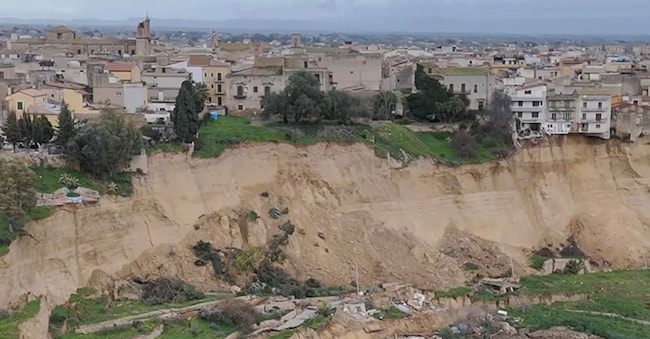
In Niscemi, the earth moved in January. But for the Gela public prosecutor's office, the landslide began much earlier: in the works that remained on paper, in the controls that were lost along the way, in the millions allocated and never transformed into works. Now that open wound in the Nissena area has become a heavy judicial file, implicating thirteen people, including the last four presidents of the Sicilian Region. In the background is a nearly 30-year-long story of alarms, ordinances, unfinished projects and responsibilities that, according to the investigators, can no longer remain nameless.
The Gela public prosecutor's investigation, opened for culpable disaster and damage followed by a landslide, aims to reconstruct what happened between 2010 and 2026 around the Niscemi landslide. The register of those under investigation includes the last four presidents of the Sicilian Region, Raffaele Lombardo, Rosario Crocetta, Nello Musumeci and Renato Schifani; the former heads of the regional civil protection department Pietro Lo Monaco and Calogero Foti; the current head of the civil protection department Salvo Cocina the regional managers Vincenzo Falgares and Salvo Lizio; the implementers of the measures against hydrogeological instability Maurizio Croce, Sergio Tuminello and Giacomo Gargano; and Sebastiana Coniglio, head of the ATI that was supposed to carry out the risk mitigation works.
Explaining the direction of the investigation was the chief prosecutor of Gela, Salvatore Vella: 'Our activity is focusing on a period from 2010 to 2026 and calls into question the last four presidents of the Sicilian Region, the managers of the Civil Protection, the implementers of the hydrogeological instability and the head of the ATI that should have carried out the work after the landslide of '97. It is here, in this stretch of time, that the Public Prosecutor's Office identifies the heart of the possible omissions.
The starting point, however, remains the first major landslide in 1997. Even then, Vella recalled, there were precise indications of the works needed to reduce the risk. "Already in 1997 there were precise indications of things to be done, but they were not done. In the Region's coffers there are still 12 million euro available for the works,' said the prosecutor, pointing his finger at the most glaring contradiction of the whole affair: the funds were there, but the decisive works to make the area safe have never come to fruition.
According to the public prosecutor's office, there are no objections to the interventions carried out in the immediate aftermath of the first landslide. Instead, the critical issues are concentrated in the long subsequent phase, when the risk was known, the projects existed and the protection systems should have been maintained and updated. "In this first phase, the investigation is basically about the works that should have been carried out and were not carried out to mitigate the risk that the 2026 landslide saw, instead, realised," Vella further explained.

