
No Dante at school, the case of Islamic students exempted from studying the Divine Comedy breaks out
The headmistress was unaware of the initiative taken independently by a teacher. Valditara sent inspectors. Criticism from the entire political front
3' min read
3' min read
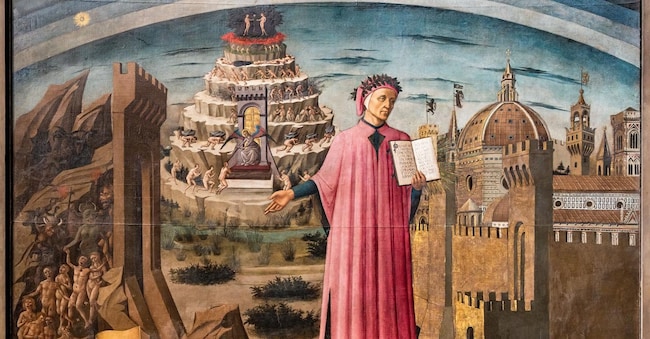
A hell, as in the Divine Comedy. The case of the two Muslim eighth-grade students from Treviso being exempted from studying Dante's Divine Comedy, which could be offensive to those who embrace Islam, is a case that also inflames politics. The decision, taken by the teacher without the school management's knowledge, has caused an uproar (one-way): everyone is against the teacher's excessive zeal.
Teacher's initiative
.Because the dispensation from Inferno, Purgatorio and Paradiso did not come after a protest; it was the professor who wrote to the parents of the two boys, asking if there were any problems in dealing with the great Alighieri's religiously motivated work with their children. The families replied that it should be avoided. The affair is still a bit steamy. The teacher is said to have tried to insist, eventually giving in to the families' niet. He had sent the same letter to the parents of other pupils who do not do religion at school. The reasoning must have been this: a text imbued with the Catholic religion could offend the sensitivities of those who do not believe, or who embrace other faiths. An alternative programme on Boccaccio was organised for the two boys.
Valditara sent inspectors
.As soon as he heard the news, Education Minister Giuseppe Valdidata decided to send inspectors to the Treviso institute, the 'Felissent', 'to verify the facts'. "The exclusion from the school curriculum of one of the pillars of our literature, for religious or cultural reasons, we still don't quite understand, is completely inadmissible".
The reactions
.A cascade of comments followed, from majority and opposition, incredulous that Dante could upset anyone. 'It is an absurdity to cancel Dante. But behind this hides an even bigger problem: fundamentalism,' declared Veneto president Luca Zaia, while the mayor of Treviso (and party colleague) Mario Conte deemed the choice 'incomprehensible'. Even more direct was League leader Matteo Salvini - 'it is demented not to study Dante because it offends someone' - and tourism minister Daniela Santanchè: 'Dante? We continue to submit to the Muslims. These politically correct people would put them among the unsuspecting'. Among the harshest judgements was that of the general-candidate Roberto Vannacci: 'Here they are,' he said, 'those who want to destroy our Italy and our identity'.
From the opposition too, the music was no different. "Knowing Dante does not take anything away from the religious confession of the children, but adds a lot to the knowledge of Italian culture. Integration is done by addition, never by subtraction," wrote PD senator Simona Malpezzi on X, while Deborah Serracchiani said she was incredulous "that one can question the study in schools of the Divine Comedy, a heritage of humanity that is essential for any cultural education, not only Italian".
The opinion of writers Rita Monaldi and Francesco Sorti was also negative, calling it an own goal to prefer Boccaccio, who "is much more difficult to digest, immoral even from the Islamic point of view", to Dante, who "was inclusive" and "leaves the door open to pagans". The headmaster of the Felissent institute, who locked herself in a closed meeting, seems to be in trouble. "I am trying to clarify what happened," said Francesca Magnano. "It is certainly a mistake to say that there was a green light, I knew nothing about this story and I am trying to clarify with the teachers involved.
Brand connect


Newsletter Scuola+
La newsletter premium dedicata al mondo della scuola con approfondimenti normativi, analisi e guide operative
Abbonati