
Nobel Prize: Farewell to William Nordhaus, the economist who developed the theory behind the carbon tax

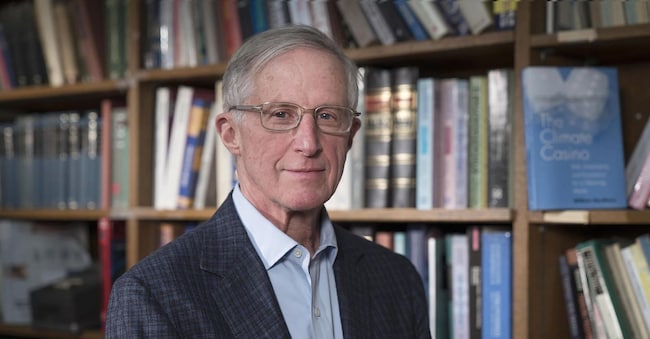
The American economist William Dawbney Nordhaus, who helped bring climate change to the forefront of economic analysis at a time when the issue was still far from being a priority for much of the scientific community and institutional circles, regarded as the father of the carbon tax, died at the age of 85 on Friday 30 October at his home in New Haven, Connecticut, from glioblastoma, a particularly aggressive form of brain tumour which he had been battling for some time. The announcement of his death was made by Yale University, where Nordhaus was professor emeritus of economics, as reported today by the *New York Times*.
Nordhaus was awarded the Nobel Prize in Economics in 2018, jointly with the American economist Paul Romer, for integrating climate change into long-term macroeconomic analysis. This citation encapsulated the significance of work carried out over more than four decades, work destined to leave a profound mark on economic research, public policy and international strategies to combat global warming. His best-known contribution is the DICE model – an acronym for Dynamic Integrated Climate-Economy – a quantitative tool designed to link economic growth, carbon dioxide emissions and climate change. Through this model, Nordhaus sought to translate a complex global problem into economic terms, making it possible to estimate the damage caused by global warming and to compare it with the costs required to reduce emissions.
The model takes into account the effects of climate change on the economy, from agricultural losses to rising sea levels, and enables an assessment of the consequences of various emission-reduction policies. The aim is to strike a balance between the costs of reducing pollution and the economic damage resulting from a failure to act. This theoretical framework has given rise to one of the most significant proposals put forward by the economist: the introduction of a price on carbon emissions through a tax, known as the carbon tax. A mechanism which, according to Nordhaus, would have made it possible to incorporate the environmental costs of productive activities into market prices, thereby correcting a distortion in the economic system. “The fundamental contribution of economics,” he stated in his Nobel Prize acceptance speech, “is to recognise that climate change is a harmful and unintended side-effect of economic growth.” The most effective solution, he added, lies in placing a cost on pollution through a tax on emissions. This insight now forms one of the cornerstones of the international debate on environmental taxation and emissions trading schemes. Nordhaus’s work has helped to cement the idea that the fight against climate change cannot be separated from economic, industrial and financial decisions, but must be integrated into development models.

