
Nobel Karman: 'Against predators we need rules'
Magnani: Trump is ceding the role of moderate country to China. Father Fortunato: halt to the instrumentalisation of religion

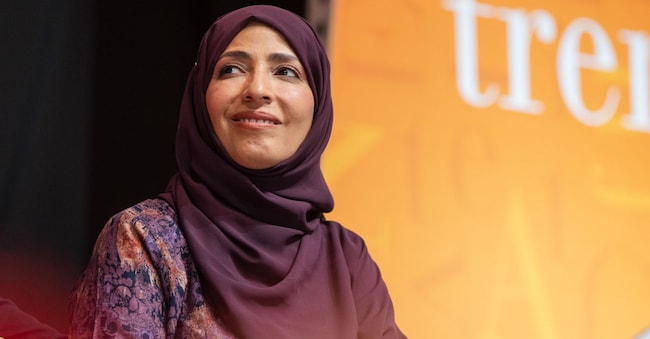
"We are living in an age of predators. In politics, economics, in the digital world. It is like a jungle, but we are not animals. We are human beings who have to build respect, have to help each other and create a different world." Tawakkol Karman won the Nobel Peace Prize in 2011. A journalist and democracy activist, she led the student uprising in Yemen in what was dubbed the 'Jasmine Revolution' that forced President Ali Abulah Saleh, since 1990 at the helm of a corrupt regime dominated by economic crisis and political repression, from power. Since then, the situation has descended into an endless civil war. With on one side the Shiite Houthi rebels, backed by Iran, who have conquered the capital area. And on the other an international coalition of nine mostly Sunni states, led by Saudi Arabia. A forgotten war in the fiery Middle East, with over 150,000 casualties, including 20,000 civilian victims.
The Nobel Peace Laureate spoke on a panel entitled 'The Age of Predators', with Mario Capanna, Pietro Modiano, Father Fortunato and Marco Magnani.
'Politicians and dictators,' Karman explains, 'use religions to foment hatred between people and justify their wars. And that is why we should really be grateful to Pope Leo when he responded to Trump by saying that no, this is not Christianity, which is a religion of peace'. The same thing happens with Islam and radical Judaism.
In these first 17 months of Donald Trump's second presidency, the world is living under the sign of the greatest uncertainty. The American president - says economist Marco Magnani - with his aggressive policy is ceding to China the role of moderate country, the power that tries to mediate, at least in words in wars. Xi, Trump, Putin: we have entered a world that I call 'muscular world' in which the strongest wins and where diplomacy no longer wins'.
In Trump's America, religion is being instrumentalised for political ends, as perhaps has not been seen since the Middle Ages. "On the dollar," recalls Father Fortunato, "there is a phrase 'In God we trust'. This says a lot about the mingling of religion and power in the USA, but even here there were those who displayed the Franciscan Tao at rallies. In the face of all this I remember the Assisi meetings, when the Popes always made it clear that true religion does not kindle hatred and division'.


