
Nobel Prize in Economics to Daron Acemoglu, Simon Johnson and James A. Robinson
Swedish Academy announces award for 2024 for studies on 'how institutions shape and influence prosperity'
3' min read
3' min read
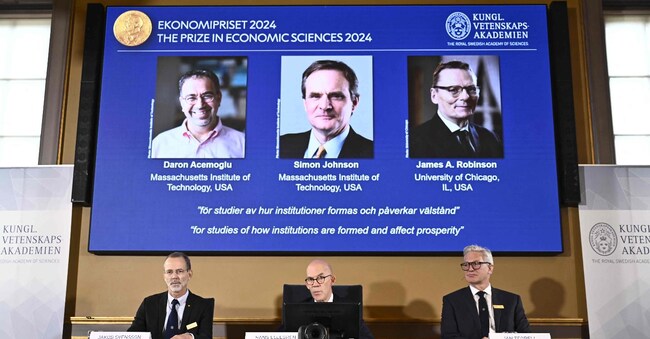
The 2024 Nobel Prize in economics goes to Daren Acemoglu, Simon Johnson, both from Mit in Boston, and James A. Robinson from the University of Chicago for their studies on "how institutions shape and influence prosperity. Reducing the huge income differences between countries is one of the greatest challenges of our time. The winners have demonstrated the importance of social institutions in achieving this goal," said Jakob Svensson, chairman of the Economic Science Prize Committee in explaining the motivations.
"When Europeans colonised large parts of the world, the institutions of those societies changed. This change was sometimes dramatic, but it did not occur everywhere in the same way. In some places, the goal was to exploit the indigenous population and extract resources for the benefit of the colonisers. In others, the colonisers created inclusive political and economic systems for the long-term benefit of European immigrants,' reads the Academy's note explaining the three economists' research. "The winners have shown that one explanation for differences in the prosperity of countries is the social institutions introduced during colonisation. Inclusive institutions were often introduced in countries that were poor at the time of colonisation and, over time, led to a generally prosperous population. This is an important reason why formerly rich colonies are now poor and vice versa. Some countries remain trapped in a situation of extractive institutions and low economic growth. The introduction of inclusive institutions would create long-term benefits for all, but extractive institutions guarantee short-term gains for those in power. As long as the political system ensures that control is maintained, no one will trust their promises of future economic reforms. According to the winners, this is why improvements do not occur. However, this inability to make credible promises of positive change may also explain why democratisation sometimes occurs. When there is a threat of revolution, the people in power are faced with a dilemma. They would prefer to stay in power and try to appease the masses by promising economic reforms, but it is unlikely that the population will believe that they will not return to the old system as soon as the situation has stabilised. In the end, the only option might be to transfer power and establish democracy'.
The award for economics closes the six-day announcement by the Academy. The prize is formally known as the Bank of Sweden Prize in Economic Sciences in memory of Alfred Nobel. The central bank established it in memory of Nobel, the 19th-century Swedish businessman and chemist who invented dynamite and established the five Nobel Prizes. The first winners were Ragnar Frisch and Jan Tinbergen in 1969.
Last year, Harvard University professor Claudia Goldin was honoured for her research that helps explain why women around the world are less likely than men to work and why they earn less money when they do. She was only the third woman among the 93 awardees for economics.
Although Nobel purists point out that the prize for economics is not technically a Nobel Prize, it is always presented with the others on 10 December, the anniversary of Nobel's death in 1896. Last week, the Nobel Prizes were announced for medicine, the physics, the chemistry, the literature and the peace.

