
Nobel Prize in Chemistry to Baker, Hassabis and Jumper for research on protein structure
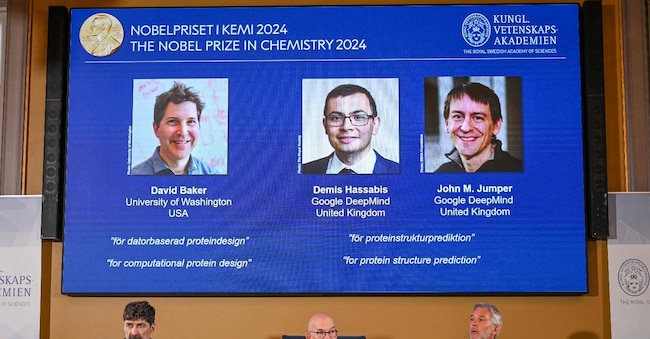
The Royal Swedish Academy of Sciences has decided to award the 2024 Nobel Prize in Chemistry to David Baker 'for the computational design of proteins' and jointly to Demis Hassabis and John M. Jumper 'for the prediction of protein structure'

2' min read
2' min read
The Royal Swedish Academy of Sciences has decided to award the 2024 Nobel Prize in Chemistry to David Baker 'for the computational design of proteins' and jointly to Demis Hassabis and John M. Jumper 'for protein structure prediction'.
In the motivation for the awarding of the 2024 Nobel Prize in Chemistry, the Swedish Academy of Sciences explains that David Baker - American, 62 years old lecturer at Seattle University - "succeeded in the almost impossible feat of building completely new types of proteins" while Englishman Demis Hassabis, 48 years old, Ceo of Google DeepMind and the American John Jumper, 39, born in Arkansas but also working in London at Google DeepMind - 'have developed an artificial intelligence model to predict the complex structures of proteins'. Discoveries that - the Swedish Royal Academy's motivations emphasise - 'have enormous potential'.
"One of the discoveries awarded this year concerns the construction of incredible proteins. The other concerns the realisation of a 50-year-old dream: predicting the structures of proteins from their amino acid sequences. Both of these discoveries open up vast possibilities,' says Heiner Linke, chairman of the Nobel Committee for Chemistry. Proteins are generally composed of 20 different amino acids, which can be described as the building blocks of life.
In 2003, David Baker succeeded in using these building blocks to design a new protein unlike any other. Since then, his research group has produced new proteins that can be used as pharmaceuticals, vaccines, nanomaterials and tiny sensors. The second discovery concerns the prediction of protein structures. In proteins, amino acids are linked together in long strings that fold to create a three-dimensional structure, decisive for the protein's function. Since the 1970s, researchers had been trying to predict protein structures from amino acid sequences, but this was notoriously difficult. However, four years ago, there was a surprising breakthrough. In fact, in 2020, Demis Hassabis andJohn Jumper presented an artificial intelligence model called AlphaFold2. With its help, they were able to predict the structure of virtually all of the 200 million proteins the researchers identified. Among the endless scientific applications, researchers can now better understand antibiotic resistance and create images of enzymes that can break down plastic.
Last year, the chemistry prize was awarded to three scientists for their work on quantum dots, tiny particles just a few nanometres in diameter that can release very bright coloured light and whose applications in everyday life include electronics and medical imaging. The six days of Nobel Prize announcements opened on Monday with the Americans Victor Ambros and Gary Ruvkun winning the prize for medicine. Two founding fathers of machine learning, John Hopfield and Geoffrey Hinton, won the prize for physics.

