Festival of Economics 2025

Nobel Spence: 'With Trump less growth but it won't be a catastrophe'

Economist brakes on risks from tariff war urges EU to focus investment on artificial intelligence
by Laura La Posta

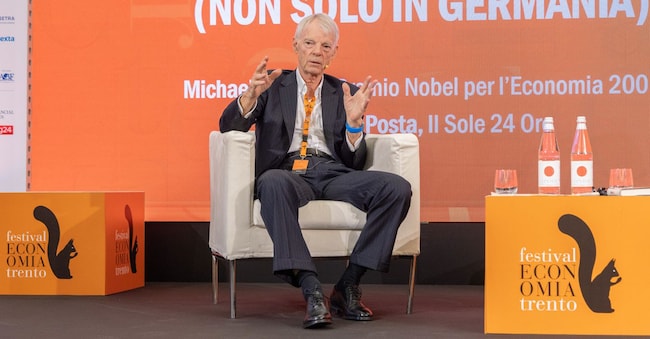
Perché la Germania si è fermata e come far ripartire la crescita (non solo in Germania)  Nella foto: Michael Spence

4' min read

4' min read

"With the Trump presidency we can only expect uncertainty, given the attitude of intervening suddenly and without thinking about the immediate consequences on the markets, and the strongest impact has been on the United States; a global slowdown can be expected in the short term because the American economy represents 25% of the world economy, but the rest of the economic system, from emerging countries to Europe, is resilient, so we can expect that Trump's policies will have important effects on growth but not catastrophic ones." Michael Spence, winner of the 2001 Nobel Prize in Economics (with two bigwigs such as George Akerlof and Joseph Stiglitz), with his positive view of the world captured the attention of the audience of mostly young people and teachers on the opening day of the Festival of Economics 2025.

While joking about leaving the United States so scarred by the Trump presidency and applying for Italian citizenship, along with his wife Giuliana and two of his five children, the American economist downplayed the current risks and alarmism. "Trump may think that everything is negotiable, but even he cannot ignore the risks on the financial markets,' he explained. 'So much so that first he announced Liberation Day (from those who have 'robbed' the US for decades, Trump said, ed.) and then after two days he suspended some duties because the bond market had gone crazy, becoming almost illiquid, and that would be a catastrophe for the financial system. Now we are at a stage where we are talking about bilateral agreements'.

Loading...

However, the risks on the American chessboard should not be underestimated: 'the US budget has to be kept under close surveillance because it is not very sustainable: the public deficit will increase and Trump will not improve things', sovereign debt at 125% of GDP 'is coming into Italian territory', interest rates are high and then 'the loss of credibility of the dollar as a reserve currency, which implies less investment in that currency, is a dangerous change of scenario'.

Spence is also a keen observer of the European economy, partly because it is to Milan that he returns when he is not teaching at Stanford University or travelling the world for conferences. It is there that he makes his home and lectures at Bocconi University and SDA, where he enjoys teaching.

'The best way to strengthen the European economy is to help strengthen the German economy, because Germany is the continental locomotive,' Spence explained. 'It has become the true European powerhouse mainly because its industrial sector has been the export leader in high value-added segments of the global supply chain for decades. While the low value-added activities moved to Eastern Europe. But this recipe no longer works today, with the current export slowdown, the effects of the war in Ukraine and the high cost of energy'.

Not surprisingly, the German government had to revise its 2025 estimates, which in early January predicted a feeble 0.3 per cent growth this year and then turned to stagnation, which would come after two years of recession. "To replicate the success of the past decades, Germany should become a leader in the digital revolution," Spence said. But it cannot do it alone. No country can do it alone to close the gap on artificial intelligence with the US and China'.

Hence Spence Spence's proposal: the EU should concentrate investments and create a large joint European research system on artificial intelligence, a field that requires huge amounts of capital and huge databases that cannot be managed by individual member states. "We cannot leave the development of artificial intelligence, in particular generative intelligence, to private companies, not least because they find it hard to see beyond company borders," the Nobel Prize winner added.

"Certainly,' the economist added, 'in the transition period between the current system and the one based on generative artificial intelligence, many jobs are likely to be lost, but in the meantime, the increase in productivity that we have been pursuing for some time will be achieved, and economic growth should therefore be restarted, driven also by the strong investments announced in the defence sector and by the push towards European productive and energy self-sufficiency, which is necessary to mitigate dependence on the United States and other countries.

For now, however, growth appears to be a mirage. But Spence has clear ideas on growth, having been awarded the Nobel Prize for his contribution to understanding how markets work (labour markets in particular) and having chaired the World Bank's Growth Commission.

Yet, the economist does not hide the difficulties of the scenario outlined, characterised by major geopolitical and social shocks. 'The current one,' Spence acknowledged, 'is a context dominated by uncertainty'. Already last year, the Nobel Prize winner had described this scenario of crises destined not to be resolved but to remain chronic, presenting the book 'Permacrisis. A plan to repair a broken world', written with former British Prime Minister Gordon Brown and finance guru Mohamed El-Erian.

However, this scenario characterised by crisis and uncertainty must not discourage governments and citizens, and young people in particular. In front of an audience in the marvellous Depero hall of the Palazzo della Provincia, made up mainly of teachers and students, Spence questioned the most effective advice to give young people at this time of transition to a world in which everyone will have a digital assistant, whether they want to or not. "My advice is to follow one's passions at all times, whether they relate to literature or technology," he said. "Of course, we will need more data scientists and software engineers, but for the first time we are facing the Ia revolution that everyone can access democratically, without the need for training. So it is not necessary to specialise to reap the benefits'.

The final applause of the audience and the subsequent siege by reporters certified the interest in Michael Spence's optimistic but pragmatic vision.

Copyright reserved ©
Loading...

Brand connect

Loading...

Newsletter

Notizie e approfondimenti sugli avvenimenti politici, economici e finanziari.

Iscriviti