
Sound-absorbing barriers to reduce noise and maintain efficiency
Over the past ten years, Turin-based Sts Isolamenti has invested around 700,000 euros in R&D and patents to bring customised solutions to the market

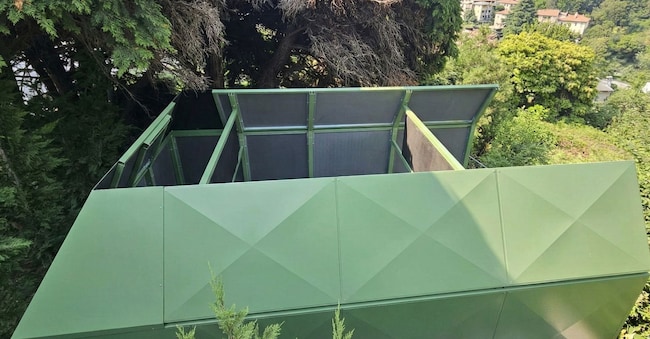
Technology also makes noise. 5G networks, data centres and artificial intelligence systems not only produce innovation, but can also have an impact on noise pollution. On the one hand, high-density servers for Ia require continuously running cooling and air handling systems. On the other, the need to reduce latency is moving the construction of large data centres ever closer to urban centres. The 'culprit' is often not the server room, but what keeps it alive: cooling units, fans and cooling towers switched on 24 hours a day, with a constant, often low-frequency hum. Here the challenge is twofold: to reduce noise without increasing consumption. Many traditional sound insulation solutions, based on rock wool panels and barriers, attenuate decibels but can 'throttle' airflow. Thus, more powerful fans or larger systems are needed to provide the same cooling.
The Challenge
It is in this delicate balance between performance and noise reduction that Sts Isolamenti, a Turin-based cleantech company specialising in soundproofing, operates. "The real challenge is not to reduce noise, but to do so without penalising plant performance," explains Giorgio Cellerino, CEO and founder of the company. Over the last ten years, Sts has invested around 700,000 euros in R&D and patents to bring to the market 'tailor-made' solutions such as those created under the Fonois brand name: sound-absorbing barriers just 1.5 cm thick, thinner baffles and curved solutions for acoustic insulation. "In most cases we realise abatements between 10 and 25 decibels, but recently we are supplying enclosures for a data centre in Germany with an abatement of 22 dB," Cellerino points out. These are modular enclosures designed to contain noise without hindering the operation of the system. And there is also a chapter on sustainability: 'The sound-absorbing part is made of 80 per cent cotton fluff, mainly obtained from clothing remnants, and for the outer part we use at least 50 per cent recycled iron,' says the CEO.
In addition to the use of waste materials, the environmental benefit is twofold: on the one hand the reduction of noise pollution, and on the other a more efficient plant operation, without forcing the machines to 'push' more. "These enclosures also protect the machines, which are often located outside, from the weather, extending their life cycle and reducing energy consumption during hotter periods," adds Cellerino. Who also claims an advantage in terms of space containment: "In data centres, Fonois solutions can occupy up to 60 per cent less space than traditional ones, optimising the organisation of environments and limiting the need for new building surfaces".

