Review after Cannes 2026

Nordic tradition triumphs at Mipim

The exhibition closes by going beyond the focus on yields and development volumes, but focusing on the needs of a West in transition and transformation. Design prevails for a built space as an instrument of cohesion, respect for the context and care for those who inhabit it

by Maria Chiara Voci

Ion Riva

6' min read

Translated by AI
Versione italiana

6' min read

Translated by AI
Versione italiana

The spotlights of Mipim 2026 have just turned off and, as we pull back the threads of four days of conferences and meetings, a new ethical vision of the market emerges forcefully. Real estate is no longer measured only by transaction numbers, returns or development volumes, but through the demands that intercept the deep needs of a western society in transformation. Sustainability remains a founding pillar, but the advancing paradigm shift concerns something more subtle: the way architecture is conceived before it is built.

The one that wins Mipim Awards today, that gets the best clients and builds value over time is born of relationships: between designer and client, between building and city, between community and built space. A sensitivity rooted in the northern European tradition of architecture studios, where it has been taught for decades that design is not a technical response to a functional problem, but a cultural act: built space as an instrument of cohesion, of respect for the context, of care for those who inhabit it.

Loading...

Nordic model conquers Turkey for low cultural density model

When a Turkish developer, who has just gone through the biggest earthquake catastrophe in his country's recent history, decides to entrust the masterplan of his project to Snøhetta, BIG and MVRDV, he is not buying signatures. He is acquiring a method. Among the most emblematic developments showcased at Mipim 2026 is the case of Ion Riva, an 84-hectare masterplan in the Riva area, north of Istanbul. The project, presented in a section of the Turkish stand, was told to us by entrepreneur Mehmet Kalyoncu himself, who espoused 'the Nordic vision' as a cultural philosophy. "After the 2023 earthquakes," he tells us, "I led the first participatory civic planning in Turkish history. An urban design plan built with the state, but designed for communities. An experience that radically changed my idea of what it means to develop a territory. I realised that there was another way of doing development. Finding solutions that focus on the ability to combine territory and people's needs becomes a goal to look at with increasing attention'.

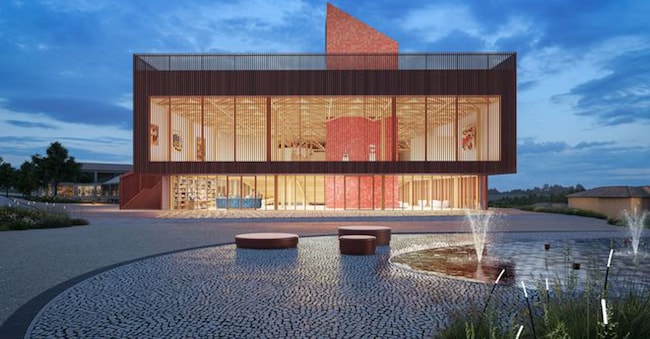
Ion Riva, an experimental urban district combining housing, public spaces, cultural facilities and services in a low-density neighbourhood integrated into the natural landscape, was born from this pact. Three cultural landmarks. The Ring by Snøhetta, a circular structure suspended over a river that will house cultural and public spaces. The Drop by BIG, in basalt and wood overlooking the Black Sea, intended for cultural and meeting functions. The Lantern by MVRDV, a building with an accessible public roof, designed as a vantage point and civic space. Around it, residences and services in dialogue with nature. The first residents of the new neighbourhood are expected in 2027.

Narrating its essence on the stand designed especially for MIPIM is Snøhetta co-founder Kjetil Trædal Thorsen himself. "We have long focused our attention on sustainability and today we find ourselves at an advantage," he tells us. "You always have to start with the design and from there develop reasoning also on materials, working alongside the customer and designing together. There is too much division in the world today, too much logic of opposites while we need harmony. With this project, the first realised in Turkey, our logic is not to attack a market but rather to set useful examples for the formation of a culture of respect for the environment. We love to be experimental, to build in a community way, to grow connections organically. The best thing in the world, in the end, is to share'.

Designing Democracy in Times of Crisis

Again from Mipim and again from the School of the North, another example of democracy comes from the presentation of two projects, in Oslo and London respectively, which show how it is possible to respond architecturally to trauma, violence and insecurity. The first case, presented on Norway's stand, is the New Government Quarter in Oslo, the first phase of which was completed in February 2026. The development stands exactly where a bomb killed eight people on 22 July 2011. Nordic Office of Architecture, together with Haptic Architects, won the 2016 international competition with a declared guiding principle 'design for democracy'.

Five new and two restored buildings are arranged around walkable squares, with restaurants, bicycle lanes, a museum dedicated to 22 July open to all, and some three hundred works of art integrated into the spaces. It is a ministerial quarter that does not close itself off from the city but gives it back routes. The project with a final budget of around £1.9 billion was delivered on time and within the parliamentary ceiling. "We have laid the foundation for this architecture to last more than 300 years," Knut Hovland, partner at Nordic Office of Architecture, tells us. Transparency is not only in the materials, but in the decisions, in the conviction that cooperation was the only possible way. It is a place designed to contemplate and remember: local materials, public art and spaces open to the city tell the memory of 22 July. We don't know exactly what it will be like a hundred years from now, but the foundations are there'.

A similar philosophy drives Salisbury Square in London, where Eric Parry Architects is completing the City's new civic hub by the end of 2026. Eighteen courtrooms, the new headquarters of the City of London Police, offices and an expanded public square. Here, security comes through transparency. The corten exoskeleton of the police headquarters features a 24-metre open span on the ground floor that is fully visible from the square. A clear architectural gesture at a time when European cities obsessively discuss security and control.

North wins in Cannes

In light of these interviews during the fair, the outcome of the Awards is not surprising. Paris and Copenhagen took the most honours at the MIPIM Awards 2026 with projects such as BPM, La Fondation, Home.Earth Nærheden and Nordhavn winning awards in their respective categories. Then came the UK with the best new-build case and the Lelystad logistics centre in the Netherlands. The Special Jury Prize went to the Sydney Fish Market designed by Danish studio 3XN. Two cities, one Danish studio. This is no coincidence. It is the geography of a cultural model.

Nordhavn, awarded Best Urban Regeneration Project, is perhaps the most eloquent example. The masterplan signed by COBE with Sleth, Polyform and Rambøll represents the largest metropolitan development operation in Northern Europe. 3.6 million square metres in Copenhagen's former industrial harbour conceived as an urban archipelago, a sequence of dense neighbourhoods overlooking the water. It is not the rigid vision of an ideal city prescribing every detail, but a robust and flexible guide designed to guide future generations of planners. Nordhavn is also the first new urban district in the world to be awarded DGNB Gold certification for sustainability and is designed as a 'five-minute city'. Shops, schools, offices and transport are within walking distance from anywhere in the district.

The Sydney Fish Market takes this philosophy to another latitude. Opening on 19 January 2026, it is the largest fish market in the southern hemisphere and a new civic landmark for Sydney. A 24-hour hub where workers, residents and visitors meet on the waterfront. The heart of the project is the large 20,000 square metre undulating roof. A structure composed of 594 glulam beams and 407 aluminium pyramid boxes integrated with photovoltaic panels designed to filter natural light and reduce the need for artificial lighting by 15 per cent. The complexity of the wooden structure reveals the Nordic gesture in its essence. Transforming an industrial infrastructure into an open civic space where the wholesale fish market becomes a public spectacle and the waterfront returns to the city.

The third Danish case awarded at Cannes tells a more intimate story. Home.Earth Nærheden, Best Residential, a project by EFFEKT and Tegnestuen Vandkunsten, consists of 158 flats made of untreated pine wood in Hedehusene in the Copenhagen metropolitan area. With a carbon footprint of 4.7 kg CO2 per square metre per year, 60 per cent below the requirements of the Danish building code, it is the most sustainable multi-storey residential building in the country built at no extra cost compared to conventional construction. Energy comes entirely from the ground via heat pumps and geothermal foundation piles. Affordable rents, no storage, shared spaces designed for the community. It is not future, but established present. It is industrial prefabrication applied with cultural consistency by a firm that has been practising this philosophy since 1970. In Copenhagen, it is the contemporary building market.

Copyright reserved ©
Loading...

Brand connect

Loading...

Newsletter RealEstate+

La newsletter premium dedicata al mondo del mercato immobiliare con inchieste esclusive, notizie, analisi ed approfondimenti

Abbonati