
Norris wins the final Dutch Grand Prix
A twelfth different podium finish out of twelve this Formula 1 season: Antonelli’s seventh victory slips away two days before his birthday

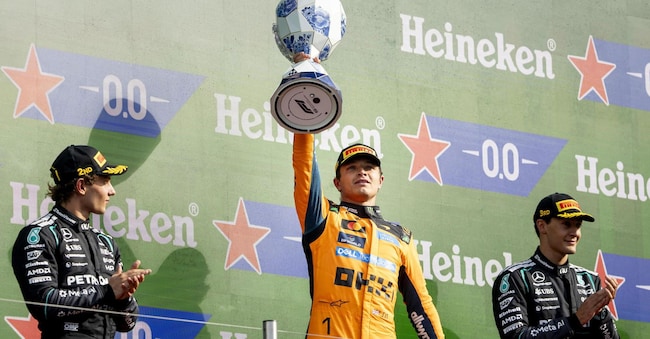
Lando Norris finished the Zandvoort race just as he had finished the Budapest race: on pole and with a win. The reigning champion secured McLaren’s second consecutive victory, following five Grands Prix with five different winners, finishing ahead of Andrea Kimi Antonelli and George Russell. Hamilton was fourth, followed by Leclerc, Piastri and Lawson. The twelfth race of the year also produced an unprecedented podium – the twelfth out of twelve. Antonelli, who turns twenty on Tuesday, remains the biggest beneficiary in the championship standings: six wins, ten podium finishes and a lead that has risen to 59 points over Russell and Hamilton, who are now level on points.
The start immediately takes Verstappen out of the running
With the tarmac still wet from the rain that had fallen right up until just before the start, the Dutchman lost control of his Red Bull in the treacherous conditions of the first lap and crashed into the barriers on the elevated section: red flag. He escaped unharmed, but it was a brutal end to the final home race for a driver who had won three times in a row at Zandvoort since the Grand Prix returned in 2021. Shortly afterwards, Bortoleto also spun out on the same section of the track; Bearman, on the following formation lap, came to a standstill with no power and further delayed the restart. The real race played out between Norris and Antonelli, with strategies and safety car periods shuffling the positions several times. The World Championship leader had the pace to stay ahead, and this time Mercedes prioritised team interests: when Russell slowed down his faster team-mate, he ceded the position, avoiding a repeat of the internal duel that had cost them points in Spain. Norris, however, was in a league of his own: he overtook Antonelli with a ‘Tarzan’ manoeuvre and extended his lead to eleven seconds, leaving no room for a comeback.
It’s a more significant sign than the result
On Saturday, in the Sprint race won by Russell ahead of Leclerc, Norris finished third, complaining of a rear end lacking grip. McLaren tweaked the car between the Sprint and qualifying, took pole position and, in the race, confirmed that Budapest was no one-off. The package unveiled in Hungary featuring the new underbody was completed at Zandvoort with a revised rear wing, central bodywork and rear brake ducts. Mercedes, on the other hand, turned up with just a single declared change to the front corner, a far cry from the substantial package expected after the break. The technical advantage seen in the opening races is no longer there. Ferrari confirmed a better race pace than the third row, but failed to convert it into a podium finish. In the closing stages, Hamilton, on much fresher Soft tyres, catches up with Russell, who is forced to defend himself on Hards that are now on their last legs; behind them, Leclerc is also closing in. A Virtual Safety Car, brought out due to debris left by Ocon’s Haas, interrupts Ferrari’s attack at their best moment and gives Mercedes some breathing space. Russell held on until the finish line; Hamilton finished fourth and Leclerc fifth; Piastri finished only sixth. Audi saw Hulkenberg finish eighth, whilst Alonso fought his way back up to ninth place ahead of Gasly.
Antonelli still has a couple of reservations about the team’s management: towards the end of the race, he reported via radio that something didn’t feel quite right, suggesting a loss of aerodynamic efficiency, and he disagreed with the decision to pit during a yellow flag period. After the finish, he ‘doubled down’ and complained about a possible strategic error. But the overall outcome, after a weekend that began with two poor qualifying sessions, remains positive: second place, a growing lead in the Drivers’ Championship and Russell once again behind him. The technical picture, however, is shifting: Mercedes still leads both World Championships, but McLaren has won two races in a row and Ferrari is breathing down their necks.
The paradox
The paradox is that Zandvoort is disappearing just as it is demonstrating what the ‘fan experience’ really means. Formula 1 is increasingly conflating the sport with hospitality, premium lounges and ancillary entertainment. Here, it was designed for those who pay for a ticket to see the cars: a compact circuit, grandstands right next to the action, excellent views, and a station just a 15-minute walk away. Over the weekend, the Dutch rail network runs a train every five minutes from Amsterdam and estimates around fifty thousand passengers a day; on Saturday there were queues and delays, but the efficiency remains difficult to replicate elsewhere. Zandvoort and the neighbouring towns have closed their roads to ordinary traffic; cycling and Park+Bike are part of the system, not an exception. A tried-and-tested model that risks being phased out without the honour it deserves.


