
Norton gets a makeover: the revolutionary 450 Urban makes its debut
The British brand is entering a new market segment with a compact motorbike that brings the design language and build quality of the new generation to a model designed for everyday commuting and trips out of town

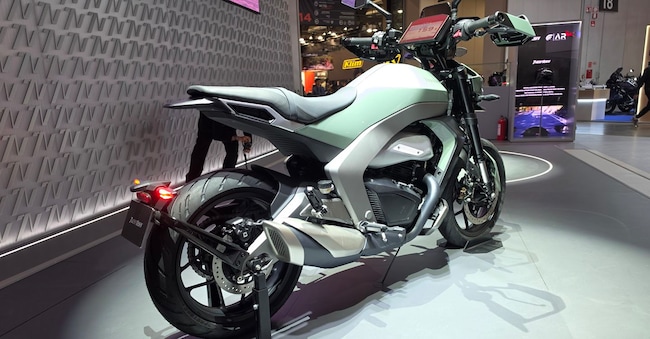
Norton, with its new 450 Urban making its world debut at EICMA 2026, is expanding its range with a model that is a first for the brand. Available in two versions sharing the same engine and chassis, they differ in their styling. The first of the two has a more road-oriented set-up, with 17-inch silver alloy wheels, a silver frame and road tyres. The second, on the other hand, has a more rugged look, with black wheels, a grey frame and swingarm, larger mudguards, as well as hand guards, fork guards, a windscreen and a dedicated seat. The design, in general, is characterised by its aluminium frame, whilst the proportions are engineered to ensure optimum performance.
It is worth noting that on both versions, the seat is low and narrow; the lowered fuel tank and the surfaces that slope down towards the front help to make the motorbike more compact and easier to handle in urban manoeuvres. According to the manufacturer, the design is reminiscent of the 1927 Norton CS1, particularly in the line connecting the rear wheel, swingarm, frame and fuel tank. This is complemented by a refined aesthetic, with visible fixings kept to a minimum, a concealed fuel cap and a covered engine. The debut of the new motorbike forms part of ‘Resurgence’, the relaunch programme backed by investments in excess of 200 million pounds.
Available in two versions
Both versions are fitted with a 454 cc, liquid-cooled single-cylinder engine, which produces 47 cv at 8,000 rpm and a maximum torque of 45 Nm at 6,000 rpm. It features a six-speed gearbox and comes fitted with a quickshifter. The power output falls within the limits set for the A2 licence. Norton has focused on progressive power delivery and a responsive throttle at low and medium revs, characteristics designed to make riding in traffic easier and maintain good acceleration even outside built-up areas. The fuel tank has a capacity of 12 litres, whilst the kerb weight is stated as less than 180 kg.

