
Not only e-cars for mobility. Jets will fly by burning Saf
Biofuels do not require modifications to existing engines but cost more than conventional ones

2' min read
2' min read
Not only battery electrics on the road to carbon neutrality in the automotive industry. In fact, in addition to the main road of lithium-ion cars, imposed by the EU with little regard for technical neutrality, there is also the solution of sensible fuels, so-called e-fuels, and biofuels, which can contribute, especially on the circulating fleet or on special cars (supercars for example) to reducing CO2 emissions. In fact, the European Union itself seems intent on extending the life of internal combustion cars by opening up the use of alternative fuels from the middle of the next decade. E-fuels are mainly produced in Germany and Iceland, while Italy is focusing on biofuels (on whose veto the EU could backtrack), with Eni at the forefront in their production.
E-fuels are obtained through the electrolysis of water and the synthesis of CO2. Using renewable energy, hydrogen is extracted from water and carbon from CO2 to create hydrocarbons. This process produces hydrogen and carbon monoxide, which combine to form a liquid energy carrier. Carbon neutrality is achieved by offsetting the CO2 emitted by vehicles with that captured from the atmosphere to produce e-fuels. They can be used in various forms, but they are not without flaws: they do not guarantee zero emissions, they cost more than conventional fuels and they are available in limited quantities.
Biofuels, on the other hand, are derived from agricultural raw materials, such as waste and waste from maize or soya cultivation. Unlike fossil fuels, they come from organic substances and do not require modifications to existing engines, ensuring good performance. It should be noted that biofuels are carbon neutral as they release the same amount of CO2 into the atmosphere as is absorbed during photosynthesis. Their cost is higher than traditional fuels.
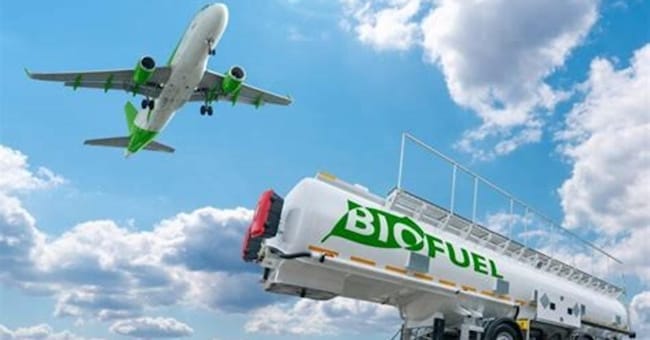
From the tarmac to the sky: the use of biofuels or synthetic fuels does not only concern passenger cars or heavy-duty vehicles, but also aircraft. Here, however, the road to the decarbonisation of aviation, scheduled for 2050, is all uphill, as one cannot build a commercial electric plane with current technologies, but can only fly small aircraft with a few seats, certainly nothing comparable to a Boeing 737 or an Airbus A320, just to stay on the small side for short to medium haul.
The reason is simple: the mass at take-off would be the same as at landing because no fuel is consumed during the flight, moreover, at present batteries weigh too much and the energy density is not comparable to that of jet fuel (kerosene). A solution to compensate for emissions that cannot be reduced originally comes from both the hydrogen hypothesis and the so-called Saf (sustainable aviation fuel), which are made from plant and industrial waste, but the costs are still very high, although there is no shortage of experiments.


