
Not only Pfas: the EU debate on chemical safety rules
At the event organised by the ECR Group in the European Parliament, the European Chemicals Agency, the Commission and industry discuss how to reconcile health, innovation and competitiveness

Key points
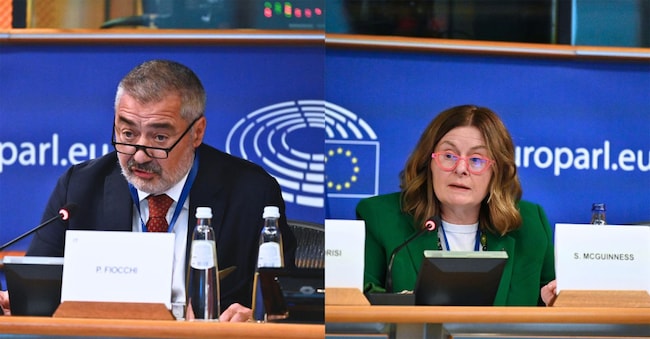
There is a crucial game for the future of Europe, one that decides how much room to give to innovation, how much to the protection of health and the environment and how much to industrial competitiveness. A balance that appeared more fragile than ever in Brussels, at the headquarters of the European Parliament, when on 14 October a debate between ECHA - the European Chemicals Agency - the European Commission and industry representatives, entitled "Regulation, Safety and Competitiveness: ECHA's role in European industry and environment", was staged by the European Conservatives and Reformists Group (ECR).
ECHA: a technical referee in a political field
"ECHA is not a legislator, but a centre of scientific expertise,' Sharon McGuinness, the Agency's Executive Director, made it clear from the outset. Its task is to enforce European rules on chemicals, ensuring that every product placed on the market is assessed and managed in a safe manner. We want enforceable, science-based and predictable laws. We don't need more rules, we need better rules, she pointed out. She then hinted at a paradigm shift: more transparency, more digitalisation and risk assessment integrating new artificial intelligence tools. The aim must be to simplify without weakening: 'Simplification does not mean cutting protection, but making the system more effective for citizens and businesses.
The REACH node: protection yes, but no paralysis
The Regulation REACH (Registration, Evaluation, Authorisation and Restriction of Chemicals) is the backbone of Europe's chemical policy. It requires those who manufacture or import chemicals to register them and demonstrate their safety. It is considered a model in the world, but also a regulatory maze for companies, so much so that the European Commission has intervened by setting the publication of the proposed major changes in order to simplify, modernise and strengthen enforcement.
MEP Petro Fiocchi (ECR), the European Parliament's contact person with ECHA and host of the meeting, issued a clear warning: 'Simplification must not mean banning more. We must make the rules more understandable and ensure that those who abide by the rules are not penalised'. Fiocchi went on to underline a real risk: 'If we ban a substance in Europe but then import products that contain it, we are only shifting pollution, not reducing it'.
On the industrial side, the president of Federchimica, Francesco Buzzella, recognised the value of the REACH Regulation, but denounced the growing administrative impact: 'The complexity of the system shifts resources from research to bureaucracy. Small and medium-sized enterprises are the most affected: we must lighten the burden and introduce serious economic impact analyses'. There is one principle on which Buzzella insisted: risk must be assessed in its context, not in the abstract. In other words, 'we need an approach based on real risk, not just on potential danger'.


