Cannes Film Festival

'Notre salut', a political manifesto at the time of the Vichy government

In competition at the Cannes Film Festival is the new feature film by Emmanuel Marre. Starring Swann Arlaud
by Andrea Chimento

Notre salut

3' min read

Translated by AI
Versione italiana

3' min read

Translated by AI
Versione italiana


French cinema in competition at Cannes is once again returning to tell the story of the Second World War: after "Moulin", centred on a famous exponent of the transalpine Resistance, Jean Moulin, and directed by the Hungarian László Nemes, it is the turn of "Notre salut" by Emmanuel Marre, a director returning to the Croisette five years after the presentation of "Generation Low Cost" at the Semaine de la Critique.

Loading...

If in that 2021 film, co-written with Julie Lecoustre, he focused on the life of a young flight attendant, with 'Notre salut' he completely changes style and historical moment, focusing on one of the most complicated periods of the last century.

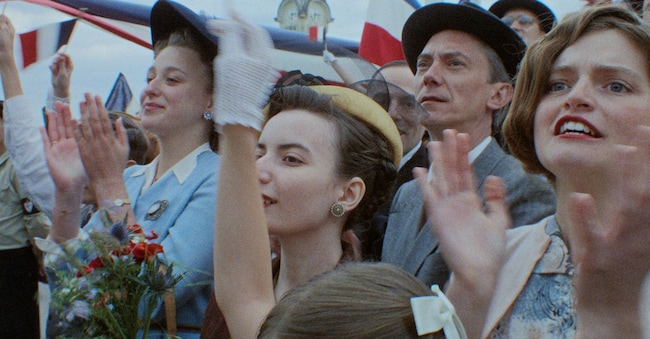
Set in 1940, the film stars Henri Marre, a man who arrives alone in Vichy with the aspiration of finding a political role within the new regime.

In his suitcase is a political manifesto entitled 'Notre salut', an essay he has written and hopes to publish as soon as possible, in which his entire philosophy is described. Henri says he wants to save France and declares himself strongly patriotic, but perhaps his main goal is to save himself above all.
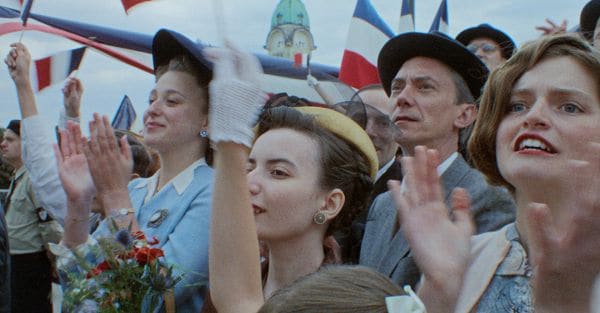

The first sequence is enough to understand how Emmanuel Marre has chosen a semi-documentary style to take us as realistically and naturally as possible into that historical context: the constant use of the hand-held video camera contributes to immediately introducing us into an anomalous story, similar in structure to many others we have already seen but nevertheless capable of having its own personality due to the representation of the main character.


Notre salut

Family memories

Director Emmanuel Marre said that the main character is inspired by his great-grandfather and the film is actually based on the correspondence and letters he wrote during the war.

This aspect makes the product undoubtedly intimate and personal, justifying even more attention to the psychological facets of a controversial character very well played by Swann Arlaud, an actor we had already admired in 'Petit paysan' and 'Anatomy of a Fall', who here gives one of the most significant roles of his career.

It is a pity that in this tale of remarkable premise there is a prolixity and length (about 155 minutes) that is not justified in relation to how the story is told.

There is no shortage of food for thought, but it is diluted in a feature film that ends up being too uneven.


Her Private Hell

Her Private Hell

Among the most eagerly awaited titles in the Cannes out-of-competition is 'Her Private Hell' by cult Danish director Nicolas Winding Refn, who has signed major films such as 'Valhalla Rising' and 'Drive' in his career.

Ten years after 'The Neon Demon', Refn returns with a feature film (in between there were also two TV series 'Too Old to Die Young' and 'Copenhagen Cowboy') that is decidedly mysterious and difficult to interpret: set in a futuristic metropolis shrouded in constant fog, the film stars Elle, a deeply tormented young woman trying to reconnect with her father.

Refn's style is entirely recognisable, but the Danish director has taken, in this case, a totally sterile and annoying stylistic turn, incapable of offering stimuli beyond those offered by images that are really too contrived and refined.

Within a sinuous frame, in this case, there is no picture worth seeing and the result is a feature film of devastating conceptual poverty, incapable of reminding us how much the Danish auteur is (was?) a filmmaker capable of thinking strongly about the language of the Seventh Art.

Copyright reserved ©
Loading...

Brand connect

Loading...

Newsletter

Notizie e approfondimenti sugli avvenimenti politici, economici e finanziari.

Iscriviti